Ch. 7 - Transcendental Functions
Hass - Thomas' Calculus 15th Edition
Hass15th EditionThomas' CalculusISBN: 9780137616077Not the one you use?Change textbook
Chapter 7, Problem 7.1.49c

c. Find the slopes of the tangent lines to the graphs of f and g at (1, 1) and (−1, −1) (four tangent lines in all).

Verified step by step guidance
1
Identify the functions \( f(x) \) and \( g(x) \) whose tangent line slopes you need to find. The problem refers to points \((1, 1)\) and \((-1, -1)\), so ensure you have the explicit forms of \( f(x) \) and \( g(x) \) before proceeding.
Find the derivatives \( f'(x) \) and \( g'(x) \) of the functions \( f(x) \) and \( g(x) \) respectively. The derivative represents the slope of the tangent line at any point \( x \). Use differentiation rules such as the power rule, product rule, or chain rule as needed.
Evaluate the derivative \( f'(x) \) at \( x = 1 \) to find the slope of the tangent line to \( f \) at the point \( (1, 1) \). Similarly, evaluate \( f'(x) \) at \( x = -1 \) to find the slope at \( (-1, -1) \).
Evaluate the derivative \( g'(x) \) at \( x = 1 \) to find the slope of the tangent line to \( g \) at the point \( (1, 1) \). Then evaluate \( g'(x) \) at \( x = -1 \) to find the slope at \( (-1, -1) \).
Summarize the four slopes obtained: two from \( f'(x) \) at \( x = 1 \) and \( x = -1 \), and two from \( g'(x) \) at the same points. These represent the slopes of the tangent lines to the graphs of \( f \) and \( g \) at the given points.

Verified video answer for a similar problem:

This video solution was recommended by our tutors as helpful for the problem above.
Video duration:
1m
Was this helpful?

Key Concepts

Here are the essential concepts you must grasp in order to answer the question correctly.

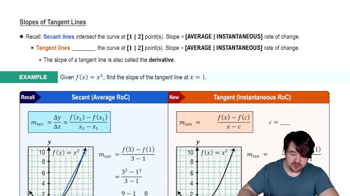
Derivative as the Slope of the Tangent Line

The derivative of a function at a given point represents the slope of the tangent line to the graph at that point. It measures the instantaneous rate of change of the function with respect to the independent variable.
Recommended video:
05:13
Slopes of Tangent Lines

Evaluating the Derivative at Specific Points

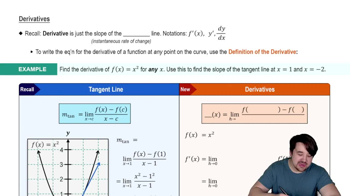
To find the slope of the tangent line at a particular point, you first compute the derivative function and then substitute the x-coordinate of the point into this derivative. This yields the slope value at that exact location.
Recommended video:
05:44
Derivatives

Understanding the Coordinates of Points on the Graph

The points given, such as (1, 1) and (−1, −1), lie on the graphs of the functions f and g. Confirming these points satisfy the function equations ensures the tangent lines are correctly evaluated at valid points on the curves.
Recommended video:
6:02
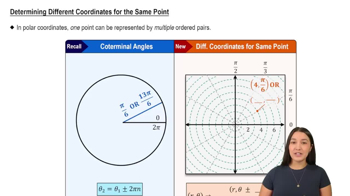
Determining Different Coordinates for the Same Point
Related Practice
Textbook Question

Use reference triangles in an appropriate quadrant to find the angles in Exercises 1–8.

1. c. tan^(-1)(1/√3)

Textbook Question

10. True, or false? As x→∞,

c. 1/x - 1/x² = o(1/x)

Textbook Question

In Exercises 41–44:


c. Evaluate df/dx at x = a and df⁻¹/dx at x = f(a) to show that

(df⁻¹/dx)|ₓ₌f(a) = 1 / (df/dx)|ₓ₌a


44. f(x) = 2x², x ≥ 0, a = 5

Textbook Question

In Exercises 67–72, you will explore some functions and their inverses together with their derivatives and tangent line approximations at specified points. Perform the following steps using your CAS:

c. Find the equation for the tangent line to f at the specified point (x_0, f(x_0)).

67. y= √(3x-2), 2/3 ≤ x ≤ 4, x_0=3

Textbook Question

In Exercises 67–72, you will explore some functions and their inverses together with their derivatives and tangent line approximations at specified points. Perform the following steps using your CAS:

c. Find the equation for the tangent line to f at the specified point (x_0, f(x_0)).

68. y= (3x+2)/(2x-11), -2 ≤ x ≤ 2, x_0=1/2

Textbook Question

23. Human evolution continues The analysis of tooth shrinkage by C. Loring Brace and colleagues at the University of Michigan’s Museum of Anthropology indicates that human tooth size is continuing to decrease and that the evolutionary process has not yet come to a halt. In northern Europeans, for example, tooth size reduction now has a rate of 1% per 1000 years.

c. What will be our descendants’ tooth size 20,000 years from now (as a percentage of our present tooth size)?