Ch. 7 - Transcendental Functions
Hass - Thomas' Calculus 15th Edition
Hass15th EditionThomas' CalculusISBN: 9780137616077Not the one you use?Change textbook
Chapter 7, Problem 7.4.23c

23. Human evolution continues The analysis of tooth shrinkage by C. Loring Brace and colleagues at the University of Michigan’s Museum of Anthropology indicates that human tooth size is continuing to decrease and that the evolutionary process has not yet come to a halt. In northern Europeans, for example, tooth size reduction now has a rate of 1% per 1000 years.
c. What will be our descendants’ tooth size 20,000 years from now (as a percentage of our present tooth size)?

Verified step by step guidance
1
Identify the given rate of tooth size reduction: 1% per 1000 years. This means the tooth size decreases by 1% every 1000 years.
Express the rate of change as a decay factor per 1000 years. Since the size decreases by 1%, the remaining size after 1000 years is 100% - 1% = 99%, or 0.99 as a decimal.
Determine the number of 1000-year intervals in 20,000 years by dividing 20,000 by 1000, which gives 20 intervals.
Use the exponential decay formula to find the tooth size after 20 intervals: \(\text{Final size} = (0.99)^{20} \times \text{Initial size}\). Since we want the percentage relative to the present size, the initial size can be considered 100%.
Calculate the expression \((0.99)^{20}\) to find the percentage of the present tooth size remaining after 20,000 years.

Verified video answer for a similar problem:

This video solution was recommended by our tutors as helpful for the problem above.
Video duration:
3m
Was this helpful?

Key Concepts

Here are the essential concepts you must grasp in order to answer the question correctly.

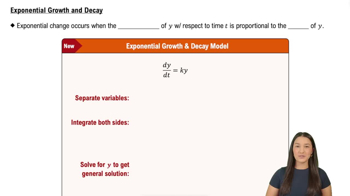
Exponential Decay

Exponential decay describes a process where a quantity decreases at a rate proportional to its current value. In this problem, tooth size reduces by a fixed percentage over equal time intervals, which fits an exponential decay model. The formula used is final size = initial size × (1 - decay rate)^time.
Recommended video:
09:29
Exponential Growth & Decay

Percentage Rate of Change

The percentage rate of change quantifies how much a quantity increases or decreases relative to its current value over a specific period. Here, tooth size decreases by 1% every 1000 years, meaning each 1000-year interval reduces the size to 99% of its previous value.
Recommended video:
04:16
Intro To Related Rates

Time Scaling in Decay Problems

Time scaling involves adjusting the decay formula to account for different time spans. Since the rate is given per 1000 years, to find the change over 20,000 years, multiply the number of intervals (20,000 ÷ 1000 = 20) and apply the decay rate repeatedly for each interval.
Recommended video:
05:03
Initial Value Problems