Ch. 7 - Transcendental Functions
Hass - Thomas' Calculus 15th Edition
Hass15th EditionThomas' CalculusISBN: 9780137616077Not the one you use?Change textbook
Chapter 7, Problem 7.5.88c

88. Given that x>0, find the maximum value, if any, of
c. x^(1/x^n) (n a positive integer)

Verified step by step guidance
1
Start by expressing the given function in a form that is easier to differentiate. The function is \(f(x) = x^{\frac{1}{x^n}}\). To simplify differentiation, take the natural logarithm: \(\ln f(x) = \frac{1}{x^n} \ln x\).
Define \(g(x) = \ln f(x) = \frac{\ln x}{x^n}\). To find critical points of \(f(x)\), find where the derivative of \(g(x)\) equals zero, since \(f(x)\) and \(g(x)\) have maxima at the same \(x\) values (because the logarithm is a monotonic function).
Differentiate \(g(x)\) using the quotient rule: \(g'(x) = \frac{(1/x) \cdot x^n - \ln x \cdot n x^{n-1}}{(x^n)^2}\). Simplify the numerator and denominator carefully.
Set \(g'(x) = 0\) and solve for \(x\). This will give the critical points where the function \(f(x)\) could have maxima or minima. Remember, \(x > 0\) and \(n\) is a positive integer.
Analyze the critical points by using the second derivative test or by examining the behavior of \(f(x)\) around these points to determine if the critical points correspond to a maximum value.

Verified video answer for a similar problem:

This video solution was recommended by our tutors as helpful for the problem above.
Video duration:
7m
Was this helpful?

Key Concepts

Here are the essential concepts you must grasp in order to answer the question correctly.

Function Analysis and Domain

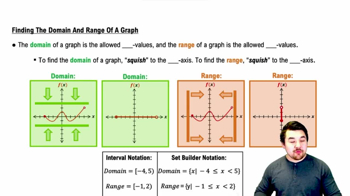
Understanding the domain of the function x^(1/x^n) is crucial, especially since x > 0 and n is a positive integer. This ensures the function is well-defined and real-valued, allowing us to analyze its behavior and find extrema within the positive real numbers.
Recommended video:
5:10
Finding the Domain and Range of a Graph

Logarithmic Differentiation

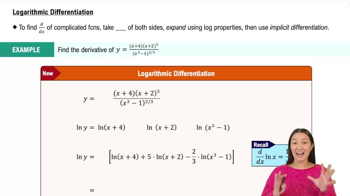
Logarithmic differentiation simplifies finding the derivative of functions with variable exponents, like x^(1/x^n). By taking the natural logarithm, the exponent becomes a product, making it easier to apply differentiation rules and identify critical points.
Recommended video:
06:30
Logarithmic Differentiation

Finding and Classifying Critical Points

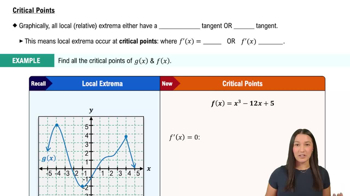
To find the maximum value, we set the derivative equal to zero to locate critical points. Then, using the second derivative test or analyzing the sign changes of the first derivative, we determine whether these points correspond to maxima, minima, or neither.
Recommended video:
04:50
Critical Points