Ch. 7 - Transcendental Functions
Hass - Thomas' Calculus 15th Edition
Hass15th EditionThomas' CalculusISBN: 9780137616077Not the one you use?Change textbook
Chapter 7, Problem 7.2.39

Evaluate the integrals in Exercises 39–56.
39. ∫(from -3 to -2)dx/x

Verified step by step guidance
1
Identify the integral to be evaluated: \(\int_{-3}^{-2} \frac{1}{x} \, dx\).
Recognize that the integrand \(\frac{1}{x}\) is a standard function whose antiderivative is \(\ln|x|\).
Write the antiderivative: \(F(x) = \ln|x| + C\).
Apply the Fundamental Theorem of Calculus by evaluating \(F(x)\) at the upper and lower limits: compute \(F(-2) - F(-3)\).
Express the definite integral as \(\ln|-2| - \ln|-3|\) and simplify using logarithm properties if needed.

Verified video answer for a similar problem:

This video solution was recommended by our tutors as helpful for the problem above.
Video duration:
2m
Was this helpful?

Key Concepts

Here are the essential concepts you must grasp in order to answer the question correctly.

Improper Integrals

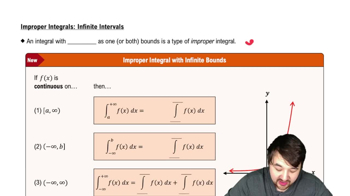
An integral is improper if the integrand is undefined or unbounded within the interval of integration. Since the function 1/x is undefined at x = 0, and the interval [-3, -2] does not include zero, the integral is proper here. However, understanding improper integrals is essential when the interval includes points where the function is undefined.
Recommended video:
11:11
Improper Integrals: Infinite Intervals

Definite Integral of 1/x

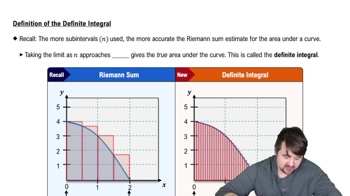
The integral of 1/x with respect to x is ln|x| + C. When evaluating a definite integral of 1/x over an interval that does not cross zero, you compute the difference of the natural logarithms of the absolute values of the endpoints. This requires careful attention to the domain and sign of x.
Recommended video:
05:43
Definition of the Definite Integral

Properties of the Natural Logarithm Function

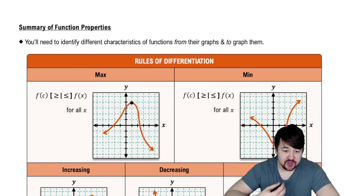
The natural logarithm function ln(x) is defined for positive x and has properties such as ln(a) - ln(b) = ln(a/b). When integrating 1/x, the absolute value ensures the argument of ln is positive, allowing evaluation over negative intervals by considering ln|x|. Understanding these properties helps correctly evaluate integrals involving 1/x.
Recommended video:
06:21
Properties of Functions