Ch. 7 - Transcendental Functions
Hass - Thomas' Calculus 15th Edition
Hass15th EditionThomas' CalculusISBN: 9780137616077Not the one you use?Change textbook
Chapter 7, Problem 4.7.14b

Finding Antiderivatives
In Exercises 1–16, find an antiderivative for each function. Do as many as you can mentally. Check your answers by differentiation.
(-3/2)csc²x(3x/2)

Verified step by step guidance
1
Identify the function to find the antiderivative of: \(-\frac{3}{2} \csc^{2}x \left( \frac{3x}{2} \right)\).
Rewrite the function for clarity: \(-\frac{3}{2} \cdot \frac{3x}{2} \cdot \csc^{2}x = -\frac{9x}{4} \csc^{2}x\).
Recognize that the function is a product of \(x\) and \(\csc^{2}x\), so consider using integration by parts, where you let \(u = x\) and \(dv = \csc^{2}x \, dx\).
Compute \(du = dx\) and find \(v\) by integrating \(dv\): since \(\int \csc^{2}x \, dx = -\cot x\), then \(v = -\cot x\).
Apply the integration by parts formula: \(\int u \, dv = uv - \int v \, du\), so the antiderivative is \(-\frac{9}{4} \left( x(-\cot x) - \int (-\cot x) \, dx \right)\).

Verified video answer for a similar problem:

This video solution was recommended by our tutors as helpful for the problem above.
Video duration:
4m
Was this helpful?

Key Concepts

Here are the essential concepts you must grasp in order to answer the question correctly.

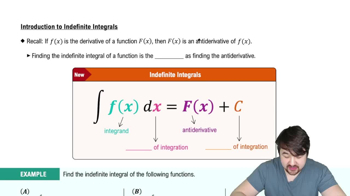
Antiderivatives (Indefinite Integrals)

An antiderivative of a function is another function whose derivative equals the original function. Finding antiderivatives involves reversing differentiation, often using known integral formulas. The result includes an arbitrary constant since differentiation of a constant is zero.
Recommended video:
05:04
Introduction to Indefinite Integrals

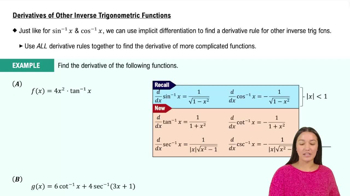
Trigonometric Functions and Their Derivatives

Understanding the derivatives of trigonometric functions like csc²x is essential. For example, the derivative of cotangent is -csc²x, which helps identify antiderivatives involving csc²x. Recognizing these relationships simplifies integration of trigonometric expressions.
Recommended video:
06:35
Derivatives of Other Inverse Trigonometric Functions

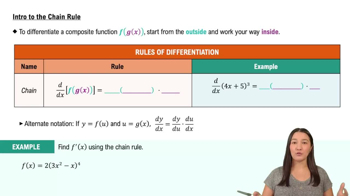
Chain Rule and Substitution Method

When functions are composed, such as csc²(3x/2), the chain rule applies in differentiation. To find antiderivatives, substitution reverses this process by setting the inner function as a variable, simplifying the integral and allowing use of basic integral formulas.
Recommended video:
05:02
Intro to the Chain Rule