Ch. 7 - Transcendental Functions
Hass - Thomas' Calculus 15th Edition
Hass15th EditionThomas' CalculusISBN: 9780137616077Not the one you use?Change textbook
Chapter 7, Problem 7.4.47

47. Carbon-14 The oldest known frozen human mummy, discovered in the Schnalstal glacier of the Italian Alps in 1991 and called Otzi, was found wearing straw shoes and a leather coat with goat fur, and holding a copper ax and stone dagger. It was estimated that Otzi died 5000 years before he was discovered in the melting glacier. How much of the original carbon-14 remained in Otzi at the time of his discovery?

Verified step by step guidance
1
Understand that the problem involves exponential decay, specifically the decay of carbon-14 over time. The amount of carbon-14 decreases according to the formula for radioactive decay.
Recall the radioactive decay formula: \(N(t) = N_0 \times e^{-\lambda t}\), where \(N(t)\) is the amount of carbon-14 remaining after time \(t\), \(N_0\) is the original amount, and \(\lambda\) is the decay constant related to the half-life.
Identify the half-life of carbon-14, which is approximately 5730 years. Use this to find the decay constant \(\lambda\) using the formula \(\lambda = \frac{\ln(2)}{T_{1/2}}\), where \(T_{1/2}\) is the half-life.
Substitute the given time \(t = 5000\) years and the decay constant \(\lambda\) into the decay formula to express the fraction of carbon-14 remaining: \(\frac{N(t)}{N_0} = e^{-\lambda t}\).
Evaluate the expression \(e^{-\lambda t}\) to find the proportion of the original carbon-14 remaining in Otzi at the time of discovery.

Verified video answer for a similar problem:

This video solution was recommended by our tutors as helpful for the problem above.
Video duration:
3m
Was this helpful?

Key Concepts

Here are the essential concepts you must grasp in order to answer the question correctly.

Radioactive Decay and Half-Life

Radioactive decay is the process by which unstable isotopes lose particles over time, decreasing their quantity. The half-life is the time required for half of the original radioactive atoms to decay. For Carbon-14, the half-life is about 5730 years, which helps estimate the remaining amount after a given period.
Recommended video:
09:29
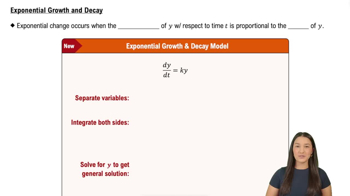
Exponential Growth & Decay

Exponential Decay Formula

The exponential decay formula models how the quantity of a radioactive substance decreases over time: N(t) = N0 * (1/2)^(t/T), where N0 is the initial amount, t is elapsed time, and T is the half-life. This formula allows calculation of the remaining Carbon-14 after thousands of years.
Recommended video:
09:29
Exponential Growth & Decay

Application of Carbon-14 Dating

Carbon-14 dating uses the known half-life of Carbon-14 to estimate the age of organic materials by measuring the remaining isotope. In Otzi's case, knowing he died 5000 years ago allows calculation of how much Carbon-14 remains, providing insight into the time elapsed since death.
Recommended video:
06:16
Real World Application