19. Show that e^x grows faster as x→∞ than x^n for any positive integer n, even x^1,000,000. (Hint: What is the nth derivative of x^n?)
Ch. 7 - Transcendental Functions
Chapter 7, Problem 7.4.9
Solve the differential equation in Exercises 9–22.
9. 2√(xy) (dy/dx) = 1, x, y > 0
Verified step by step guidance1
Rewrite the given differential equation: \(2\sqrt{xy} \frac{dy}{dx} = 1\) with \(x, y > 0\).
Isolate \(\frac{dy}{dx}\) by dividing both sides by \(2\sqrt{xy}\): \(\frac{dy}{dx} = \frac{1}{2\sqrt{xy}}\).
Express \(\sqrt{xy}\) as \(\sqrt{x} \sqrt{y}\) to separate variables: \(\frac{dy}{dx} = \frac{1}{2 \sqrt{x} \sqrt{y}}\).
Rewrite the equation to separate variables \(y\) and \(x\): multiply both sides by \(2 \sqrt{y}\) and multiply both sides by \(dx\) to get \(2 \sqrt{y} dy = \frac{1}{\sqrt{x}} dx\).
Integrate both sides: \(\int 2 \sqrt{y} \, dy = \int \frac{1}{\sqrt{x}} \, dx\), then solve the resulting integrals to find the implicit or explicit solution for \(y\).

Verified video answer for a similar problem:
This video solution was recommended by our tutors as helpful for the problem above.
Video duration:
2mWas this helpful?
Key Concepts
Here are the essential concepts you must grasp in order to answer the question correctly.
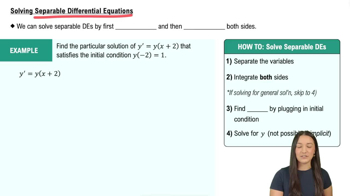
Separable Differential Equations
A separable differential equation can be written as a product of a function of x and a function of y, allowing variables to be separated on opposite sides of the equation. This enables integration with respect to each variable independently to find the solution.
Recommended video:
Solving Separable Differential Equations
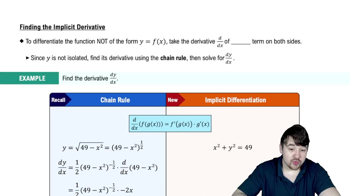
Implicit Differentiation and Manipulation
Implicit differentiation involves differentiating both sides of an equation involving x and y without explicitly solving for y. In this problem, rewriting the equation to isolate dy/dx and expressing terms in a form suitable for separation is essential.
Recommended video:
Finding The Implicit Derivative
Integration Techniques
Solving the separated equation requires integrating functions of x and y. Familiarity with integration methods, including substitution and handling radicals like √(xy), is necessary to find the explicit or implicit solution.
Recommended video:
Integration by Parts for Definite Integrals
Related Practice
Textbook Question
1
views
Textbook Question
11. Show that if positive functions f(x) and g(x) grow at the same rate as x→∞, then f=O(g) and g=O(f).
1
views
Textbook Question
In Exercises 21–48, find the derivative of y with respect to the appropriate variable.
21. y=arccos(x²)
Textbook Question
47. Carbon-14 The oldest known frozen human mummy, discovered in the Schnalstal glacier of the Italian Alps in 1991 and called Otzi, was found wearing straw shoes and a leather coat with goat fur, and holding a copper ax and stone dagger. It was estimated that Otzi died 5000 years before he was discovered in the melting glacier. How much of the original carbon-14 remained in Otzi at the time of his discovery?
1
views
Textbook Question
Evaluate the integrals in Exercises 53–76.
67. ∫dx/(2+(x-1)²)
Textbook Question
Evaluate the integrals in Exercises 39–56.
39. ∫(from -3 to -2)dx/x
1
views