Ch. 4 - Applications of Derivatives
Hass - Thomas' Calculus 15th Edition
Hass15th EditionThomas' CalculusISBN: 9780137616077Not the one you use?Change textbook
Chapter 4, Problem 4.5.16b

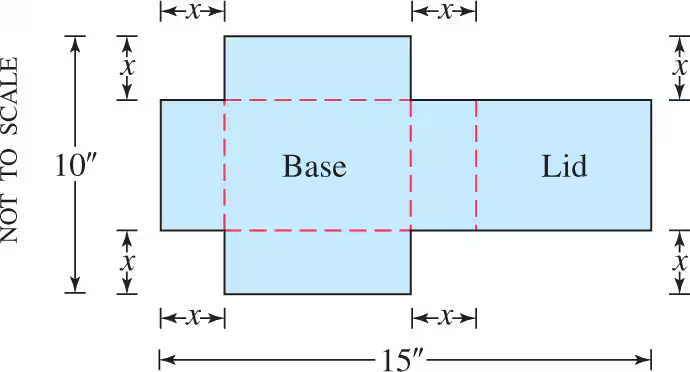
[Technology Exercise] 16. Designing a box with a lid A piece of cardboard measures 10 in. by 15 in. Two equal squares are removed from the corners of a 10-in. side as shown in the figure. Two equal rectangles are removed from the other corners so that the tabs can be folded to form a rectangular box with lid.
<IMAGE>
b. Find the domain of V for the problem situation and graph V over this domain.

Verified step by step guidance
1
Step 1: Define the variables. Let x represent the side length of the squares removed from the corners of the 10-inch side. The dimensions of the base of the box will be reduced by 2x on each side, resulting in dimensions (10 - 2x) by (15 - 2x). The height of the box will be x, as the tabs folded upward form the height.
Step 2: Write the volume formula for the box. The volume V of the box is given by the product of the base area and the height. Using the dimensions of the base and the height, the formula becomes: V = (10 - 2x)(15 - 2x)x.
Step 3: Determine the domain of x. Since x represents the side length of the squares removed, it must be positive and less than half the smaller dimension of the cardboard (10 inches). This ensures that the base dimensions remain positive. Therefore, the domain of x is 0 < x < 5.
Step 4: Analyze the behavior of V over the domain. The volume function V = (10 - 2x)(15 - 2x)x is a cubic function. To graph V, evaluate the function at various points within the domain (0, 5) and plot these values. The graph will show how the volume changes as x increases.
Step 5: Interpret the graph. The graph of V will typically start at V = 0 when x = 0, increase to a maximum value, and then decrease back to V = 0 as x approaches 5. The maximum point on the graph represents the optimal value of x that maximizes the volume of the box.

Verified video answer for a similar problem:

This video solution was recommended by our tutors as helpful for the problem above.
Video duration:
8m
Was this helpful?

Key Concepts

Here are the essential concepts you must grasp in order to answer the question correctly.

Volume of a Box

The volume of a box is calculated by multiplying its length, width, and height. In this problem, the dimensions of the box depend on the size of the squares cut from the corners, represented by 'x'. The formula for the volume V can be expressed as V = (length - 2x)(width - 2x)(height), where the height is equal to 'x' after folding the sides up.
Recommended video:
04:48
Finding Volume Using Disks

Domain of a Function

The domain of a function refers to the set of all possible input values (x-values) for which the function is defined. In this context, the domain for the volume function V must consider the constraints imposed by the dimensions of the cardboard. Specifically, 'x' must be less than half the shorter side of the cardboard to ensure that the cuts do not exceed the material available.
Recommended video:
5:10
Finding the Domain and Range of a Graph

Graphing Functions

Graphing a function involves plotting its output values against its input values on a coordinate system. For the volume function V, once the domain is established, the next step is to calculate V for various values of 'x' within that domain and plot these points to visualize how the volume changes as the size of the cut squares varies. This helps in understanding the behavior of the function and identifying maximum or minimum values.
Recommended video:
5:53
Graph of Sine and Cosine Function