
Ch. 4 - Applications of Derivatives
Hass - Thomas' Calculus 15th Edition
Hass15th EditionThomas' CalculusISBN: 9780137616077Not the one you use?Change textbook
Chapter 4, Problem 4.7.63b

Checking Antiderivative Formulas


Right, or wrong? Say which for each formula and give a brief reason for each answer.


∫xsinx dx = -x cos x + C

Verified step by step guidance
1
Recall the integration by parts formula: \(\int u \, dv = uv - \int v \, du\).
Identify parts for integration by parts: let \(u = x\) (so \(du = dx\)) and \(dv = \sin x \, dx\) (so \(v = -\cos x\)).
Apply the formula: \(\int x \sin x \, dx = -x \cos x - \int (-\cos x) \, dx = -x \cos x + \int \cos x \, dx\).
Integrate \(\int \cos x \, dx\) to get \(\sin x\), so the full antiderivative is \(-x \cos x + \sin x + C\).
Compare this with the given formula \(\int x \sin x \, dx = -x \cos x + C\); since the \(\sin x\) term is missing, the given formula is incorrect.

Verified video answer for a similar problem:

This video solution was recommended by our tutors as helpful for the problem above.
Video duration:
2m
Was this helpful?

Key Concepts

Here are the essential concepts you must grasp in order to answer the question correctly.

Antiderivative (Indefinite Integral)

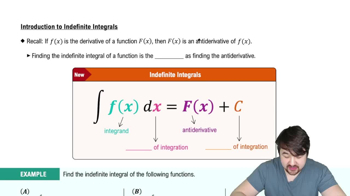
An antiderivative of a function f(x) is another function F(x) whose derivative is f(x). The indefinite integral symbol ∫ represents the family of all antiderivatives, including a constant of integration C, since differentiation of a constant is zero.
Recommended video:
05:04
Introduction to Indefinite Integrals

Integration by Parts

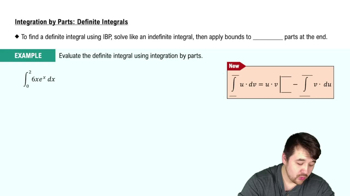
Integration by parts is a technique used to integrate products of functions. It is based on the product rule for differentiation and follows the formula ∫u dv = uv - ∫v du, where u and dv are parts of the original integrand chosen to simplify the integral.
Recommended video:
06:18
Integration by Parts for Definite Integrals

Verification of Antiderivatives

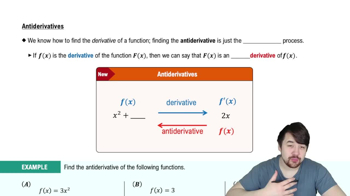
To verify if a given formula is an antiderivative, differentiate the proposed function and check if the result matches the original integrand. This method confirms correctness by reversing the integration process.
Recommended video:
05:50
Antiderivatives
Related Practice
Textbook Question

[Technology Exercise] 16. Designing a box with a lid A piece of cardboard measures 10 in. by 15 in. Two equal squares are removed from the corners of a 10-in. side as shown in the figure. Two equal rectangles are removed from the other corners so that the tabs can be folded to form a rectangular box with lid.

" style="" width="335">

b. Find the domain of V for the problem situation and graph V over this domain.

Textbook Question

Theory and Examples


In Exercises 51 and 52, give reasons for your answers.


Let f(x) = |x³ − 9x|.


b. Does f'(3) exist?

Textbook Question

Analyzing Functions from Derivatives


Answer the following questions about the functions whose derivatives are given in Exercises 1–14:


b. On what open intervals is f increasing or decreasing?


f′(x) = (x − 1)(x + 2)(x − 3)

Textbook Question

Analyzing Functions from Derivatives


Answer the following questions about the functions whose derivatives are given in Exercises 1–14:

c. At what points, if any, does f assume local maximum or minimum values?


f′(x) = (x − 1)(x + 2)(x − 3)

Textbook Question

Analyzing Functions from Derivatives


Answer the following questions about the functions whose derivatives are given in Exercises 1–14:


b. On what open intervals is f increasing or decreasing?


f′(x) = 1− 4/x², x ≠ 0

Textbook Question

Analyzing Functions from Derivatives


Answer the following questions about the functions whose derivatives are given in Exercises 1–14:


b. On what open intervals is f increasing or decreasing?


f′(x) = (x − 1)²(x + 2)