
Ch. 4 - Applications of Derivatives
Hass - Thomas' Calculus 15th Edition
Hass15th EditionThomas' CalculusISBN: 9780137616077Not the one you use?Change textbook
Chapter 4, Problem 4.7.109c

Applications


Suppose that f(x) = d/dx (1 − √x) and g(x) = d/dx (x + 2).


Find:


∫[−f(x)] dx

Verified step by step guidance
1
First, identify the functions f(x) and g(x) as derivatives given in the problem: \( f(x) = \frac{d}{dx} (1 - \sqrt{x}) \) and \( g(x) = \frac{d}{dx} (x + 2) \).
Calculate \( f(x) \) by differentiating the function inside: \( 1 - \sqrt{x} = 1 - x^{1/2} \). Use the power rule for differentiation: \( \frac{d}{dx} x^{n} = n x^{n-1} \).
Express \( f(x) \) explicitly as \( f(x) = 0 - \frac{1}{2} x^{-1/2} = -\frac{1}{2 \sqrt{x}} \).
The integral to find is \( \int -f(x) \, dx \). Substitute \( f(x) \) into the integral to get \( \int -\left(-\frac{1}{2 \sqrt{x}}\right) dx = \int \frac{1}{2 \sqrt{x}} \, dx \).
Rewrite the integral in terms of exponents: \( \int \frac{1}{2} x^{-1/2} \, dx \). Use the power rule for integration: \( \int x^{n} \, dx = \frac{x^{n+1}}{n+1} + C \), where \( n \neq -1 \).

Verified video answer for a similar problem:

This video solution was recommended by our tutors as helpful for the problem above.
Video duration:
2m
Was this helpful?

Key Concepts

Here are the essential concepts you must grasp in order to answer the question correctly.

Derivative and Differentiation

Differentiation is the process of finding the derivative of a function, which represents the rate of change or slope at any point. In this problem, f(x) and g(x) are defined as derivatives of given functions, so understanding how to compute derivatives is essential.
Recommended video:
05:53
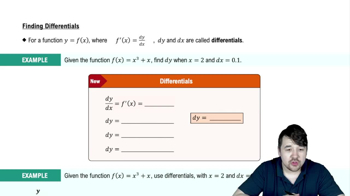
Finding Differentials

Integral and Antiderivative

Integration is the reverse process of differentiation, used to find the original function from its derivative. The integral ∫[−f(x)] dx requires finding the antiderivative of the negative of f(x), which involves applying integration rules to the derived function.
Recommended video:
05:50
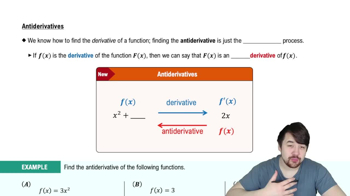
Antiderivatives

Properties of Square Roots and Power Functions

The function inside the derivative includes a square root, which can be rewritten as a power function (x^(1/2)). Understanding how to differentiate and integrate power functions, including fractional exponents, is crucial for correctly solving the problem.
Recommended video:
06:21
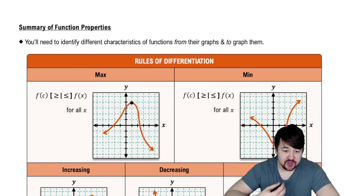
Properties of Functions
Related Practice
Textbook Question

[Technology Exercise] 16. Designing a box with a lid A piece of cardboard measures 10 in. by 15 in. Two equal squares are removed from the corners of a 10-in. side as shown in the figure. Two equal rectangles are removed from the other corners so that the tabs can be folded to form a rectangular box with lid.

" style="" width="335">

b. Find the domain of V for the problem situation and graph V over this domain.

Textbook Question

Finding Antiderivatives

In Exercises 1–16, find an antiderivative for each function. Do as many as you can mentally. Check your answers by differentiation.

x² − 2x + 1

Textbook Question

Analyzing Functions from Derivatives


Answer the following questions about the functions whose derivatives are given in Exercises 1–14:

c. At what points, if any, does f assume local maximum or minimum values?


f′(x) = (x − 1)(x + 2)(x − 3)

Textbook Question

Dependence on Initial Point

8. Using the function shown in the figure, and, for each initial estimate x_0, determine graphically what happens to the sequence of Newton’s method approximations

c. x_0=2

Textbook Question

Finding Antiderivatives

In Exercises 1–16, find an antiderivative for each function. Do as many as you can mentally. Check your answers by differentiation.

sin πx − 3sin 3x

1
views
Textbook Question

Analyzing Functions from Derivatives


Answer the following questions about the functions whose derivatives are given in Exercises 1–14:


b. On what open intervals is f increasing or decreasing?


f′(x) = (x − 1)²(x + 2)