
Textbook Question
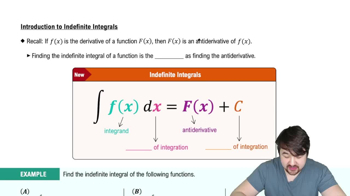
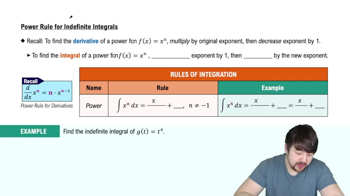
Finding Antiderivatives
In Exercises 1–16, find an antiderivative for each function. Do as many as you can mentally. Check your answers by differentiation.
√x + 1/√x

 Verified step by step guidance
 05:04
05:04
 04:04
04:04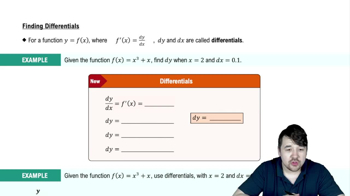 05:53
05:53Finding Antiderivatives
In Exercises 1–16, find an antiderivative for each function. Do as many as you can mentally. Check your answers by differentiation.
√x + 1/√x
Applications
Suppose that f(x) = d/dx (1 − √x) and g(x) = d/dx (x + 2).
Find:
∫[−f(x)] dx
[Technology Exercises] When solving Exercises 14–30, you may need to use appropriate technology (such as a calculator or a computer).
27. Converging to different zeros Use Newton's method to find the zeros of f(x)=4x^4-4x^2 using the given starting values.
c. x_0 = 0.8 and x_0 = 2, lying in (√2/2, ∞)
Analyzing Functions from Derivatives
Answer the following questions about the functions whose derivatives are given in Exercises 1–14:
c. At what points, if any, does f assume local maximum or minimum values?
f′(x) = (x − 1)(x + 2)(x − 3)
Dependence on Initial Point
8. Using the function shown in the figure, and, for each initial estimate x_0, determine graphically what happens to the sequence of Newton’s method approximations
c. x_0=2
Finding Antiderivatives
In Exercises 1–16, find an antiderivative for each function. Do as many as you can mentally. Check your answers by differentiation.
sin πx − 3sin 3x