
Ch. 4 - Applications of Derivatives
Hass - Thomas' Calculus 15th Edition
Hass15th EditionThomas' CalculusISBN: 9780137616077Not the one you use?Change textbook
Chapter 4, Problem 4.7.11c

Finding Antiderivatives
In Exercises 1–16, find an antiderivative for each function. Do as many as you can mentally. Check your answers by differentiation.
sin πx − 3sin 3x

Verified step by step guidance
1
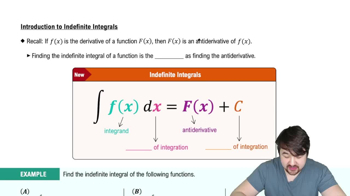
Recall that an antiderivative (or indefinite integral) of a function \( f(x) \) is a function \( F(x) \) such that \( F'(x) = f(x) \). Our goal is to find \( F(x) \) given \( f(x) = \sin(\pi x) - 3 \sin(3x) \).
Use the basic antiderivative formula for sine: \( \int \sin(ax) \, dx = -\frac{1}{a} \cos(ax) + C \), where \( a \) is a constant and \( C \) is the constant of integration.
Apply this formula to each term separately: For \( \sin(\pi x) \), the antiderivative is \( -\frac{1}{\pi} \cos(\pi x) \). For \( -3 \sin(3x) \), factor out the constant \( -3 \) and integrate \( \sin(3x) \) to get \( -3 \times \left(-\frac{1}{3} \cos(3x)\right) \).
Simplify the expression after integration: The \( -3 \times -\frac{1}{3} \) simplifies to \( +1 \), so the antiderivative of \( -3 \sin(3x) \) is \( + \cos(3x) \).
Combine the results and add the constant of integration \( C \) to write the full antiderivative: \( F(x) = -\frac{1}{\pi} \cos(\pi x) + \cos(3x) + C \).

Verified video answer for a similar problem:

This video solution was recommended by our tutors as helpful for the problem above.
Video duration:
7m
Was this helpful?

Key Concepts

Here are the essential concepts you must grasp in order to answer the question correctly.

Antiderivatives (Indefinite Integrals)

An antiderivative of a function is another function whose derivative equals the original function. Finding antiderivatives involves reversing differentiation, often represented as the indefinite integral with a constant of integration. For example, the antiderivative of sin(x) is -cos(x) + C.
Recommended video:
05:04
Introduction to Indefinite Integrals

Integration of Trigonometric Functions

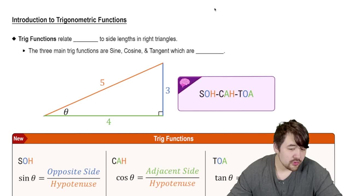
Integrating trigonometric functions like sin(kx) requires using known integral formulas and applying the chain rule in reverse. Specifically, ∫sin(kx) dx = -cos(kx)/k + C, where k is a constant. Recognizing these patterns helps in quickly finding antiderivatives mentally.
Recommended video:
6:04
Introduction to Trigonometric Functions

Verification by Differentiation

After finding an antiderivative, differentiating it should return the original function. This step confirms the correctness of the solution. For example, differentiating -cos(πx)/π yields sin(πx), verifying the antiderivative.
Recommended video:
05:53
Finding Differentials
Related Practice
Textbook Question

[Technology Exercise] 16. Designing a box with a lid A piece of cardboard measures 10 in. by 15 in. Two equal squares are removed from the corners of a 10-in. side as shown in the figure. Two equal rectangles are removed from the other corners so that the tabs can be folded to form a rectangular box with lid.

" style="" width="335">

b. Find the domain of V for the problem situation and graph V over this domain.

Textbook Question

Finding Antiderivatives

In Exercises 1–16, find an antiderivative for each function. Do as many as you can mentally. Check your answers by differentiation.

x² − 2x + 1

Textbook Question

Applications


Suppose that f(x) = d/dx (1 − √x) and g(x) = d/dx (x + 2).


Find:


∫[−f(x)] dx

1
views
Textbook Question

[Technology Exercises] When solving Exercises 14–30, you may need to use appropriate technology (such as a calculator or a computer).

27. Converging to different zeros Use Newton's method to find the zeros of f(x)=4x^4-4x^2 using the given starting values.

c. x_0 = 0.8 and x_0 = 2, lying in (√2/2, ∞)

Textbook Question

Analyzing Functions from Derivatives


Answer the following questions about the functions whose derivatives are given in Exercises 1–14:

c. At what points, if any, does f assume local maximum or minimum values?


f′(x) = (x − 1)(x + 2)(x − 3)

Textbook Question

Dependence on Initial Point

8. Using the function shown in the figure, and, for each initial estimate x_0, determine graphically what happens to the sequence of Newton’s method approximations

c. x_0=2