Ch. 4 - Applications of Derivatives
Hass - Thomas' Calculus 15th Edition
Hass15th EditionThomas' CalculusISBN: 9780137616077Not the one you use?Change textbook
Chapter 4, Problem 4.4.69

Each of Exercises 67–88 gives the first derivative of a continuous function y=f(x). Find y'' and then use Steps 2–4 of the graphing procedure described in this section to sketch the general shape of the graph of f.
69. y' = x(x - 3)²

Verified step by step guidance
1
Step 1: Start by finding the second derivative y''. To do this, differentiate the given first derivative y' = x(x - 3)² using the product rule. Recall that the product rule states: (uv)' = u'v + uv'. Here, u = x and v = (x - 3)².
Step 2: Differentiate u = x to get u' = 1. Then, differentiate v = (x - 3)² using the chain rule. The chain rule states: (g(h(x)))' = g'(h(x)) * h'(x). Here, g(h) = h² and h(x) = x - 3. So, v' = 2(x - 3)(1) = 2(x - 3).
Step 3: Apply the product rule to compute y''. Substitute u, u', v, and v' into the formula: y'' = u'v + uv'. This becomes y'' = (1)(x - 3)² + (x)(2(x - 3)). Simplify this expression to get the second derivative.
Step 4: Analyze the critical points and concavity using y'' to determine the general shape of the graph. Set y'' = 0 to find inflection points, and test intervals around these points to determine where the graph is concave up (y'' > 0) or concave down (y'' < 0).
Step 5: Combine the information from y' and y'' to sketch the general shape of the graph. Use the critical points from y' (where y' = 0) to identify maxima, minima, or points of inflection, and use the concavity information from y'' to refine the sketch of the graph.

Verified video answer for a similar problem:

This video solution was recommended by our tutors as helpful for the problem above.
Video duration:
9m
Was this helpful?

Key Concepts

Here are the essential concepts you must grasp in order to answer the question correctly.

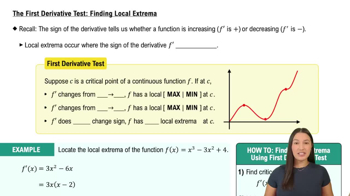
First Derivative

The first derivative of a function, denoted as y' or f'(x), represents the rate of change of the function with respect to x. It provides information about the slope of the tangent line to the graph of the function at any given point. Analyzing the first derivative helps identify critical points, where the function may have local maxima or minima.
Recommended video:
07:09
The First Derivative Test: Finding Local Extrema

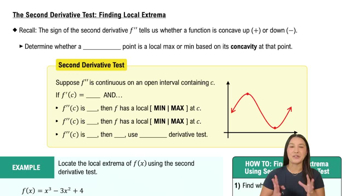
Second Derivative

The second derivative, denoted as y'' or f''(x), is the derivative of the first derivative. It indicates the rate of change of the slope of the function, providing insights into the concavity of the graph. If y'' is positive, the graph is concave up, and if y'' is negative, the graph is concave down. This information is crucial for sketching the general shape of the function.
Recommended video:
06:02
The Second Derivative Test: Finding Local Extrema

Graphing Procedure

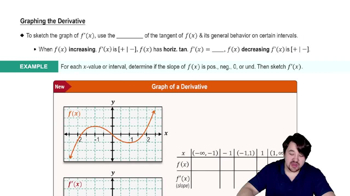
The graphing procedure involves several steps to sketch the graph of a function based on its derivatives. Steps typically include finding critical points from the first derivative, determining concavity and inflection points from the second derivative, and analyzing the behavior of the function at endpoints or asymptotes. This systematic approach helps create an accurate representation of the function's overall shape.
Recommended video:
06:15
Graphing The Derivative