
Ch. 4 - Applications of Derivatives
Hass - Thomas' Calculus 15th Edition
Hass15th EditionThomas' CalculusISBN: 9780137616077Not the one you use?Change textbook
Chapter 4, Problem 4.5.6

6. You are planning to close off a corner of the first quadrant with a line segment 20 units long running from (a, 0) to (0,b). Show that the area of the triangle enclosed by the segment is largest when a = b.

Verified step by step guidance
1
First, understand that the line segment forms a right triangle with the x-axis and y-axis. The vertices of the triangle are (0,0), (a,0), and (0,b).
The length of the line segment is given as 20 units. Using the distance formula, we have \( \sqrt{a^2 + b^2} = 20 \).
The area \( A \) of the triangle can be expressed as \( A = \frac{1}{2}ab \).
To find the maximum area, express \( b \) in terms of \( a \) using the equation from the distance formula: \( b = \sqrt{400 - a^2} \). Substitute this into the area formula to get \( A(a) = \frac{1}{2}a\sqrt{400 - a^2} \).
Differentiate \( A(a) \) with respect to \( a \) and set the derivative equal to zero to find the critical points. Solve for \( a \) and verify that the area is maximized when \( a = b \).

Verified video answer for a similar problem:

This video solution was recommended by our tutors as helpful for the problem above.
Video duration:
8m
Was this helpful?

Key Concepts

Here are the essential concepts you must grasp in order to answer the question correctly.

Equation of a Line

The equation of a line in the coordinate plane can be expressed in the form y = mx + c, where m is the slope and c is the y-intercept. For a line segment from (a, 0) to (0, b), the slope is -b/a, and the equation becomes y = (-b/a)x + b. Understanding this helps in determining the line's position and its intersection with the axes.
Recommended video:
05:14
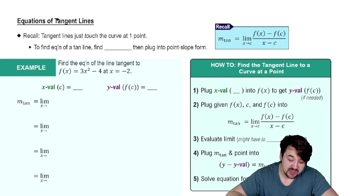
Equations of Tangent Lines

Area of a Triangle

The area of a triangle can be calculated using the formula (1/2) * base * height. In this context, the base and height are the x and y intercepts of the line segment, which are a and b, respectively. Thus, the area of the triangle formed is (1/2) * a * b, which is crucial for determining when this area is maximized.
Recommended video:
05:06
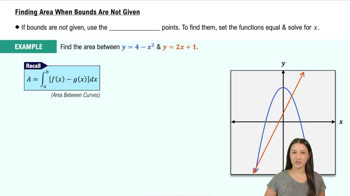
Finding Area When Bounds Are Not Given

Optimization

Optimization involves finding the maximum or minimum value of a function. Here, we need to maximize the area of the triangle, A = (1/2) * a * b, subject to the constraint that the line segment's length is 20 units, which gives the equation a^2 + b^2 = 400. Using calculus, particularly the method of Lagrange multipliers or substitution, helps find the optimal values of a and b.
Recommended video:
10:13
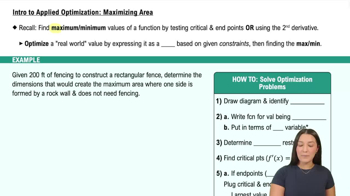
Intro to Applied Optimization: Maximizing Area