
Textbook Question
In Exercises 1–10, find the extreme values (absolute and local) of the function over its natural domain, and where they occur.
__________
y = √ 3 + 2𝓍 ―𝓍²

 Verified step by step guidance
 05:03
05:03
 05:45
05:45 05:11
05:11In Exercises 1–10, find the extreme values (absolute and local) of the function over its natural domain, and where they occur.
__________
y = √ 3 + 2𝓍 ―𝓍²
Each of Exercises 67–88 gives the first derivative of a continuous function y=f(x). Find y'' and then use Steps 2–4 of the graphing procedure described in this section to sketch the general shape of the graph of f.
69. y' = x(x - 3)²
6. You are planning to close off a corner of the first quadrant with a line segment 20 units long running from (a, 0) to (0,b). Show that the area of the triangle enclosed by the segment is largest when a = b.
Theory and Examples
[Technology Exercise] Graph the functions in Exercises 63–66. Then find the extreme values of the function on the interval and say where they occur.
f(x) = |x − 2| + |x + 3|, −5 ≤ x ≤ 5
Checking Antiderivative Formulas
Right, or wrong? Give a brief reason why.
∫−15(x + 3)² / (x − 2)⁴ dx = ((x + 3)/(x − 2))³ + C
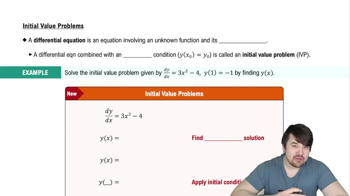
Initial Value Problems
Solve the initial value problems in Exercises 71–90.
dy/dx = 1/x² + x, x > 0; y(2) = 1