
Ch. 4 - Applications of Derivatives
Hass - Thomas' Calculus 15th Edition
Hass15th EditionThomas' CalculusISBN: 9780137616077Not the one you use?Change textbook
Chapter 4, Problem 4.7.71

Initial Value Problems


Solve the initial value problems in Exercises 71–90.


dy/dx = 2x − 7, y(2) = 0

Verified step by step guidance
1
Identify the given differential equation and initial condition: \(\frac{dy}{dx} = 2x - 7\) with \(y(2) = 0\).
Integrate the right-hand side of the differential equation with respect to \(x\) to find the general solution for \(y\). That is, compute \(y = \int (2x - 7) \, dx\).
Perform the integration: integrate \$2x\( to get \)x^2\( and integrate \)-7\( to get \)-7x\(, then add the constant of integration \)C\( to write \)y = x^2 - 7x + C$.
Use the initial condition \(y(2) = 0\) to find the value of the constant \(C\) by substituting \(x = 2\) and \(y = 0\) into the general solution.
Solve the resulting equation for \(C\) and write the particular solution \(y = x^2 - 7x + C\) with the found value of \(C\).

Verified video answer for a similar problem:

This video solution was recommended by our tutors as helpful for the problem above.
Video duration:
2m
Was this helpful?

Key Concepts

Here are the essential concepts you must grasp in order to answer the question correctly.

Differential Equations

A differential equation relates a function to its derivatives. In this problem, dy/dx = 2x − 7 expresses the rate of change of y with respect to x. Solving it means finding a function y(x) whose derivative matches the given expression.
Recommended video:
07:39
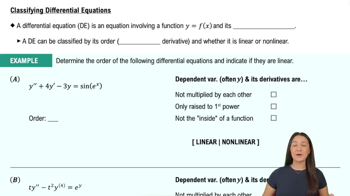
Classifying Differential Equations

Initial Value Problem (IVP)

An initial value problem specifies both a differential equation and a condition that the solution must satisfy at a particular point, here y(2) = 0. This condition helps determine the unique solution among infinitely many possible antiderivatives.
Recommended video:
05:03
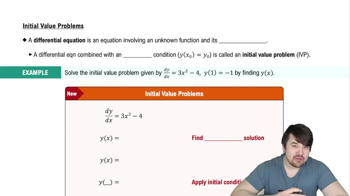
Initial Value Problems

Integration to Solve First-Order ODEs

To solve dy/dx = 2x − 7, integrate the right-hand side with respect to x to find y(x). After integration, use the initial condition to solve for the constant of integration, ensuring the solution fits the given initial value.
Recommended video:
02:42
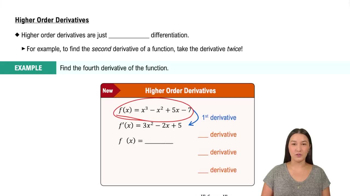
Higher Order Derivatives