Ch. 2 - Limits and Continuity
Hass - Thomas' Calculus 15th Edition
Hass15th EditionThomas' CalculusISBN: 9780137616077Not the one you use?Change textbook
Chapter 2, Problem 4d

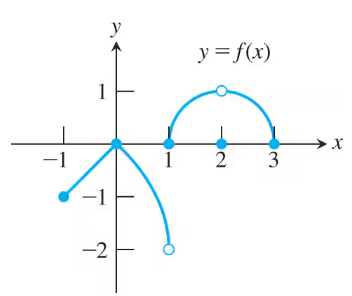
Which of the following statements about the function y=f(x) graphed here are true, and which are false?


d. limx→c f(x) exists at every point c in (-1,1).


img

Verified step by step guidance
1
To determine if the limit \( \lim_{x \to c} f(x) \) exists at every point \( c \) in the interval \((-1, 1)\), we need to analyze the behavior of the function \( f(x) \) as \( x \) approaches each point \( c \) within this interval.
Recall that for the limit \( \lim_{x \to c} f(x) \) to exist, the left-hand limit \( \lim_{x \to c^-} f(x) \) and the right-hand limit \( \lim_{x \to c^+} f(x) \) must both exist and be equal.
Examine the graph of \( f(x) \) within the interval \((-1, 1)\) to identify any discontinuities, jumps, or asymptotic behavior that might cause the limit to not exist at certain points.
Pay special attention to any points where the function might have a hole, a vertical asymptote, or a jump discontinuity, as these are common reasons for a limit to not exist.
If the graph shows a continuous curve without any breaks or jumps within the interval \((-1, 1)\), then the limit exists at every point in that interval. Otherwise, identify the specific points where the limit does not exist.

Verified video answer for a similar problem:

This video solution was recommended by our tutors as helpful for the problem above.
Video duration:
6m
Was this helpful?

Key Concepts

Here are the essential concepts you must grasp in order to answer the question correctly.

Limits

A limit is a fundamental concept in calculus that describes the behavior of a function as its input approaches a certain value. It helps determine the value that a function approaches, which may not necessarily be the function's value at that point. Understanding limits is crucial for analyzing continuity and differentiability of functions.
Recommended video:
05:50
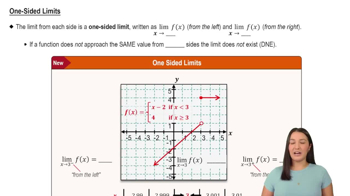
One-Sided Limits

Continuity

A function is continuous at a point if the limit of the function as it approaches that point equals the function's value at that point. For a function to be continuous over an interval, it must be continuous at every point within that interval. This concept is essential for determining whether the limit exists at a given point.
Recommended video:
05:34
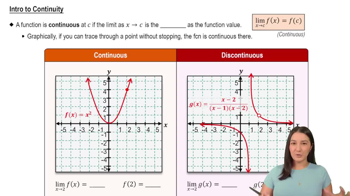
Intro to Continuity

Piecewise Functions

Piecewise functions are defined by different expressions based on the input value. Understanding how these functions behave in different intervals is important for analyzing their limits and continuity. When evaluating limits for piecewise functions, one must consider the specific expression that applies to the point of interest.
Recommended video:
05:36
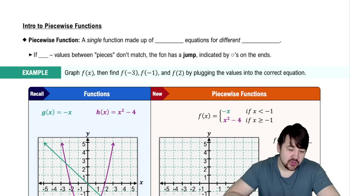
Piecewise Functions