Ch. 2 - Limits and Continuity
Hass - Thomas' Calculus 15th Edition
Hass15th EditionThomas' CalculusISBN: 9780137616077Not the one you use?Change textbook
Chapter 2, Problem 5

Limits and Continuity


In Exercises 5 and 6, find the value that lim (x→0) g(x) must have if the given limit statements hold.


lim ((4―g(x)) / x ) = 1
x→0

Verified step by step guidance
1
Understand the problem: We need to find the value of lim (x→0) g(x) given that lim ((4 - g(x)) / x) = 1 as x approaches 0.
Recall the definition of a limit: The limit of a function as x approaches a certain value is the value that the function approaches as x gets closer to that value.
Set up the equation based on the given limit statement: Since lim ((4 - g(x)) / x) = 1, we can express this as lim (x→0) (4 - g(x)) / x = 1.
Apply the limit property: As x approaches 0, the expression (4 - g(x)) must approach a value such that when divided by x, the result is 1. This implies that (4 - g(x)) must approach x as x approaches 0.
Solve for g(x): Rearrange the equation 4 - g(x) = x to find g(x). As x approaches 0, g(x) must approach 4 to satisfy the limit condition.

Verified video answer for a similar problem:

This video solution was recommended by our tutors as helpful for the problem above.
Video duration:
2m
Was this helpful?

Key Concepts

Here are the essential concepts you must grasp in order to answer the question correctly.

Limits

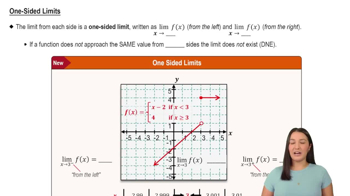
Limits are fundamental in calculus, representing the value that a function approaches as the input approaches a certain point. In this context, we are interested in the limit of the function g(x) as x approaches 0. Understanding limits helps in analyzing the behavior of functions near specific points, which is crucial for solving the given problem.
Recommended video:
05:50
One-Sided Limits

Continuity

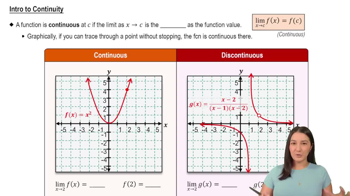
A function is continuous at a point if the limit of the function as it approaches that point equals the function's value at that point. In this case, continuity is important because it ensures that g(x) behaves predictably as x approaches 0, allowing us to deduce the necessary value of g(0) based on the limit provided.
Recommended video:
05:34
Intro to Continuity

L'Hôpital's Rule

L'Hôpital's Rule is a method used to evaluate limits of indeterminate forms, such as 0/0 or ∞/∞. In the given limit expression, if substituting x = 0 leads to an indeterminate form, applying this rule can simplify the limit calculation. This technique is particularly useful when dealing with ratios of functions, as it allows for differentiation to find the limit.
Recommended video: