Ch. 2 - Limits and Continuity
Hass - Thomas' Calculus 15th Edition
Hass15th EditionThomas' CalculusISBN: 9780137616077Not the one you use?Change textbook
Chapter 2, Problem 6

Limits and Continuity
In Exercises 5 and 6, find the value that lim (x→0) g(x) must have if the given limit statements hold.


lim (x lim g(x)) = 2
x→-4 x→0

Verified step by step guidance
1
Understand the problem: We need to find the value of lim (x→0) g(x) given that lim (x→-4) g(x) = 2. This involves understanding the behavior of the function g(x) as x approaches different values.
Recognize that the limit lim (x→-4) g(x) = 2 implies that as x approaches -4, the function g(x) approaches 2. This is a separate limit from the one we need to find, which is as x approaches 0.
Consider the continuity of g(x) around x = 0. If g(x) is continuous at x = 0, then lim (x→0) g(x) is simply g(0). However, we need more information about g(x) to determine this.
Use the given limit statement lim (x→-4) g(x) = 2 to infer any possible behavior of g(x) around x = 0. Since the limit as x approaches -4 is 2, it suggests that g(x) might be approaching a constant value, but this does not directly affect the limit as x approaches 0.
Conclude that without additional information about g(x) near x = 0, we cannot directly determine lim (x→0) g(x) from the given limit statement. More information about g(x) or its behavior near x = 0 is needed to find this limit.

Verified video answer for a similar problem:

This video solution was recommended by our tutors as helpful for the problem above.
Video duration:
2m
Was this helpful?

Key Concepts

Here are the essential concepts you must grasp in order to answer the question correctly.

Limits

A limit is a fundamental concept in calculus that describes the behavior of a function as its input approaches a certain value. It helps in understanding how functions behave near specific points, even if they are not defined at those points. For example, the limit of g(x) as x approaches 0 indicates what value g(x) approaches as x gets closer to 0.
Recommended video:
05:50
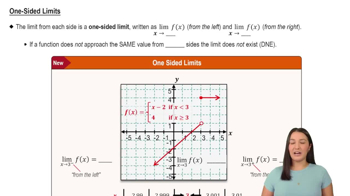
One-Sided Limits

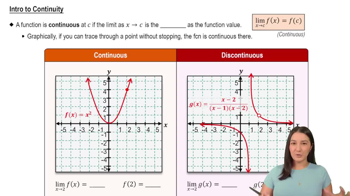
Continuity

A function is continuous at a point if the limit of the function as it approaches that point equals the function's value at that point. This concept is crucial for ensuring that there are no breaks, jumps, or holes in the graph of the function. In the context of the given limit, continuity implies that if g(x) is continuous at x=0, then the limit as x approaches 0 must equal g(0).
Recommended video:
05:34
Intro to Continuity

Composite Limits

Composite limits involve evaluating the limit of a function that is itself a limit of another function. In the given problem, lim (x→0) g(x) is part of a nested limit expression. Understanding how to evaluate these limits requires knowledge of how limits can be manipulated and combined, particularly when dealing with multiple variables or functions.
Recommended video:
05:50
One-Sided Limits