
Textbook Question
Limits and Continuity
Suppose the functions ƒ(x) and g(x) are defined for all x and that lim (x → 0) ƒ(x) = 1/2 and lim (x → 0) g(x) = √2. Find the limits as x → 0 of the following functions.
e. x + ƒ(x)

 Verified step by step guidance
 05:50
05:50
 05:34
05:34 06:15
06:15Limits and Continuity
Suppose the functions ƒ(x) and g(x) are defined for all x and that lim (x → 0) ƒ(x) = 1/2 and lim (x → 0) g(x) = √2. Find the limits as x → 0 of the following functions.
e. x + ƒ(x)
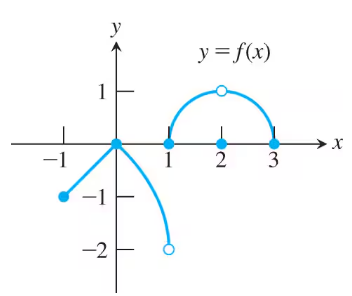
Which of the following statements about the function y=f(x) graphed here are true, and which are false?
i. f(0)=1
Which of the following statements about the function y=f(x) graphed here are true, and which are false?
c. limx→1 f(x) does not exist.
Which of the following statements about the function y=f(x) graphed here are true, and which are false?
d. limx→c f(x) exists at every point c in (-1,1).
Which of the following statements about the function y=f(x) graphed here are true, and which are false?
a. limx→2 f(x) does not exist.
Limits and Continuity
Suppose that ƒ(t) and ƒ(t) are defined for all t and that lim t → t₀ ƒ(t) = ―7 and lim (t → t₀) g (t) = 0 . Find the limit as t → t₀ of the following functions.
h. 1 / ƒ(t)