Ch. 11 - Parametric Equations and Polar Coordinates
Hass - Thomas' Calculus 15th Edition
Hass15th EditionThomas' CalculusISBN: 9780137616077Not the one you use?Change textbook
Chapter 11, Problem 11.2.14

Tangent Lines to Parametrized Curves


In Exercises 1−14, find an equation for the line tangent to the curve at the point defined by the given value of t. Also, find the value of d²y/dx² at this point.


x = t + eᵗ, y = 1 − eᵗ, t = 0

Verified step by step guidance
1
First, find the coordinates of the point on the curve at \( t = 0 \) by substituting \( t = 0 \) into the parametric equations \( x = t + e^{t} \) and \( y = 1 - e^{t} \). This gives the point \( (x_0, y_0) \).
Next, compute the derivatives \( \frac{dx}{dt} \) and \( \frac{dy}{dt} \) by differentiating each parametric equation with respect to \( t \).
Then, find the slope of the tangent line \( \frac{dy}{dx} \) at \( t = 0 \) using the chain rule for parametric curves: \( \frac{dy}{dx} = \frac{\frac{dy}{dt}}{\frac{dx}{dt}} \).
Use the point-slope form of a line to write the equation of the tangent line at the point \( (x_0, y_0) \) with slope \( \frac{dy}{dx} \): \[ y - y_0 = \left( \frac{dy}{dx} \right)(x - x_0) \].
To find the second derivative \( \frac{d^2 y}{dx^2} \) at \( t = 0 \), first compute \( \frac{d}{dt} \left( \frac{dy}{dx} \right) \), then divide by \( \frac{dx}{dt} \) using the formula: \[ \frac{d^2 y}{dx^2} = \frac{\frac{d}{dt} \left( \frac{dy}{dx} \right)}{\frac{dx}{dt}} \]. Evaluate this expression at \( t = 0 \).

Verified video answer for a similar problem:

This video solution was recommended by our tutors as helpful for the problem above.
Video duration:
11m
Was this helpful?

Key Concepts

Here are the essential concepts you must grasp in order to answer the question correctly.

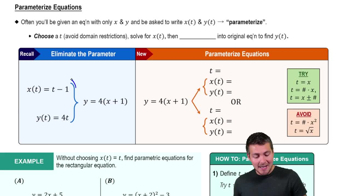
Parametric Equations and Curves

Parametric equations express the coordinates of points on a curve as functions of a parameter, usually t. Instead of y as a function of x, both x and y depend on t, allowing the description of more complex curves. Understanding how to work with these equations is essential for analyzing the curve's behavior at specific parameter values.
Recommended video:
Guided course
08:02
Parameterizing Equations

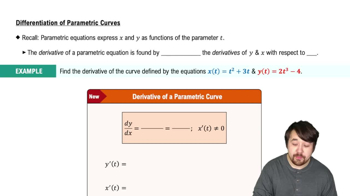
Finding the Tangent Line to a Parametric Curve

The tangent line to a parametric curve at a given t is found by computing the derivatives dx/dt and dy/dt, then using dy/dx = (dy/dt)/(dx/dt) to find the slope. The point on the curve at t gives the coordinates for the tangent point. The tangent line equation uses this slope and point to describe the line touching the curve at that parameter.
Recommended video:
06:49
Differentiation of Parametric Curves

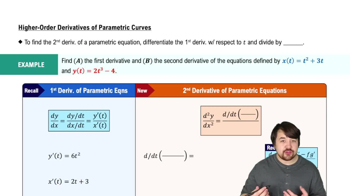
Second Derivative d²y/dx² for Parametric Curves

The second derivative d²y/dx² measures the curvature of the parametric curve and is found using the formula d²y/dx² = (d/dt(dy/dx)) / (dx/dt). This requires differentiating the slope dy/dx with respect to t and dividing by dx/dt. It provides insight into the concavity and shape of the curve at the given parameter value.
Recommended video:
06:40
Higher Order Derivatives of Parametric Curves