
Textbook Question
Eccentricities and Directrices
Exercises 29–36 give the eccentricities of conic sections with one focus at the origin along with the directrix corresponding to that focus. Find a polar equation for each conic section.
e = 2, x = 4

 Verified step by step guidance
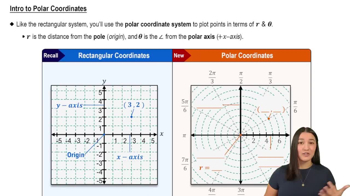
 05:32
05:32
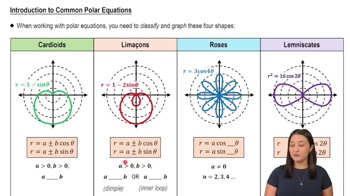 3:47
3:47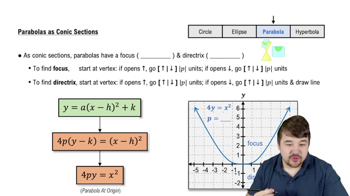 5:33
5:33Eccentricities and Directrices
Exercises 29–36 give the eccentricities of conic sections with one focus at the origin along with the directrix corresponding to that focus. Find a polar equation for each conic section.
e = 2, x = 4
Tangent Lines to Parametrized Curves
In Exercises 1−14, find an equation for the line tangent to the curve at the point defined by the given value of t. Also, find the value of d²y/dx² at this point.
x = t + eᵗ, y = 1 − eᵗ, t = 0
Lengths of Curves
Find the lengths of the curves in Exercises 25–30.
x = cos t, y = t + sin t, 0 ≤ t ≤ π
Cartesian to Polar Equations
Replace the Cartesian equations in Exercises 53–66 with equivalent polar equations.
x - y = 3
Polar to Cartesian Equations
Replace the polar equations in Exercises 27–52 with equivalent Cartesian equations. Then describe or identify the graph.
r² = 4r sin θ
Finding Parametric Equations
In Exercises 31–36, find a parametrization for the curve.
the ray (half line) with initial point (-1,2) that passes through the point (0,0)