
Ch. 11 - Parametric Equations and Polar Coordinates
Hass - Thomas' Calculus 15th Edition
Hass15th EditionThomas' CalculusISBN: 9780137616077Not the one you use?Change textbook
Chapter 11, Problem 11.7.32

Eccentricities and Directrices


Exercises 29–36 give the eccentricities of conic sections with one focus at the origin along with the directrix corresponding to that focus. Find a polar equation for each conic section.


e = 2, x = 4

Verified step by step guidance
1
Recall the general polar form of a conic section with a focus at the origin: \[ r = \frac{ed}{1 + e \cos \theta} \] where \(e\) is the eccentricity, \(d\) is the distance from the focus to the directrix, and \(\theta\) is the polar angle.
Identify the given values: eccentricity \(e = 2\) and the directrix is the vertical line \(x = 4\). Since the directrix is vertical and to the right of the origin, the directrix is located at \(x = d = 4\).
Because the directrix is vertical and to the right, the polar equation uses \(\cos \theta\) in the denominator with a negative sign if the directrix is to the right (positive \(x\)-axis). The formula becomes: \[ r = \frac{ed}{1 - e \cos \theta} \]
Substitute the known values \(e = 2\) and \(d = 4\) into the formula: \[ r = \frac{2 \times 4}{1 - 2 \cos \theta} = \frac{8}{1 - 2 \cos \theta} \]
This expression represents the polar equation of the conic section with eccentricity 2 and directrix \(x = 4\). Note that since \(e > 1\), the conic is a hyperbola.

Verified video answer for a similar problem:

This video solution was recommended by our tutors as helpful for the problem above.
Video duration:
2m
Was this helpful?

Key Concepts

Here are the essential concepts you must grasp in order to answer the question correctly.

Eccentricity of Conic Sections

Eccentricity (e) measures how much a conic section deviates from being circular. For conics with one focus at the origin, e > 1 indicates a hyperbola, e = 1 a parabola, and 0 < e < 1 an ellipse. It determines the shape and type of the conic.
Recommended video:
5:33
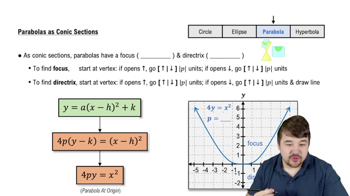
Parabolas as Conic Sections

Directrix and Its Role in Polar Equations

The directrix is a fixed line used to define conic sections. The distance from any point on the conic to the focus and to the directrix relates through eccentricity. In polar form, the directrix position helps express the conic’s equation relative to the focus at the origin.
Recommended video:
3:47
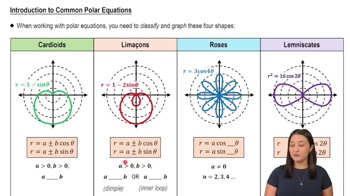
Introduction to Common Polar Equations

Polar Equation of Conic Sections

The polar equation of a conic with focus at the origin is r = ed / (1 ± e cos θ) or r = ed / (1 ± e sin θ), where d is the distance from the focus to the directrix. This formula allows converting geometric definitions into algebraic expressions in polar coordinates.
Recommended video:
5:33
Parabolas as Conic Sections