Ch. 11 - Parametric Equations and Polar Coordinates
Hass - Thomas' Calculus 15th Edition
Hass15th EditionThomas' CalculusISBN: 9780137616077Not the one you use?Change textbook
Chapter 11, Problem 11.3.19

Graphing Sets of Polar Coordinate Points


Graph the sets of points whose polar coordinates satisfy the equations and inequalities in Exercises 11–26.


θ = π/2, r ≥ 0

Verified step by step guidance
1
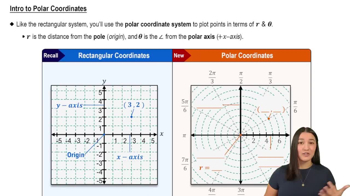
Understand the polar coordinate system: each point is represented by \((r, \theta)\), where \(r\) is the distance from the origin and \(\theta\) is the angle measured from the positive x-axis.
Given the equation \(\theta = \frac{\pi}{2}\), this means all points lie along the line where the angle is \(90^\circ\), which corresponds to the positive y-axis in Cartesian coordinates.
The inequality \(r \geq 0\) means we only consider points at a distance \(r\) from the origin that are zero or positive, so points start at the origin and extend outward along the line \(\theta = \frac{\pi}{2}\).
To graph this, draw a ray starting at the origin and extending straight up along the positive y-axis, including the origin itself since \(r\) can be zero.
Label the ray to indicate that it corresponds to \(\theta = \frac{\pi}{2}\) and \(r \geq 0\), representing all points on this line from the origin upwards.

Verified video answer for a similar problem:

This video solution was recommended by our tutors as helpful for the problem above.
Video duration:
1m
Was this helpful?

Key Concepts

Here are the essential concepts you must grasp in order to answer the question correctly.

Polar Coordinates System

The polar coordinate system represents points in a plane using a radius and an angle. Each point is defined by (r, θ), where r is the distance from the origin and θ is the angle measured from the positive x-axis. This system is useful for graphing curves and points that are naturally circular or angular.
Recommended video:
05:32
Intro to Polar Coordinates

Graphing Lines in Polar Coordinates

In polar coordinates, the equation θ = constant represents a straight line through the origin at the specified angle. For θ = π/2, the line is vertical, corresponding to the positive y-axis in Cartesian coordinates. Points on this line have varying r values but a fixed angle.
Recommended video:
05:32
Intro to Polar Coordinates

Inequalities in Polar Coordinates

Inequalities like r ≥ 0 restrict the set of points to those with non-negative radius values. Since r represents distance, r ≥ 0 includes all points on or in front of the origin along the line θ = π/2. Negative r values would reflect points in the opposite direction.
Recommended video:
05:32
Intro to Polar Coordinates