
Ch. 11 - Parametric Equations and Polar Coordinates
Hass - Thomas' Calculus 15th Edition
Hass15th EditionThomas' CalculusISBN: 9780137616077Not the one you use?Change textbook
Chapter 11, Problem 11.PE.24

Polar to Cartesian Equations


Sketch the lines in Exercises 23-28. Also, find a Cartesian equation for each line.


r cos (θ − 3π/4) = (√2)/2

Verified step by step guidance
1
Recall the polar to Cartesian coordinate conversions: \(x = r \cos \theta\) and \(y = r \sin \theta\).
Use the cosine difference identity to expand \(\cos(\theta - \frac{3\pi}{4})\): \(\cos(\theta - \frac{3\pi}{4}) = \cos \theta \cos \frac{3\pi}{4} + \sin \theta \sin \frac{3\pi}{4}\).
Substitute the known values \(\cos \frac{3\pi}{4} = -\frac{\sqrt{2}}{2}\) and \(\sin \frac{3\pi}{4} = \frac{\sqrt{2}}{2}\) into the expression.
Rewrite the original equation \(r \cos(\theta - \frac{3\pi}{4}) = \frac{\sqrt{2}}{2}\) as: \(r \left( -\frac{\sqrt{2}}{2} \cos \theta + \frac{\sqrt{2}}{2} \sin \theta \right) = \frac{\sqrt{2}}{2}\).
Replace \(r \cos \theta\) with \(x\) and \(r \sin \theta\) with \(y\) to get a Cartesian equation in terms of \(x\) and \(y\). Simplify this equation to find the Cartesian form of the line.

Verified video answer for a similar problem:

This video solution was recommended by our tutors as helpful for the problem above.
Video duration:
3m
Was this helpful?

Key Concepts

Here are the essential concepts you must grasp in order to answer the question correctly.

Polar Coordinates and Their Components

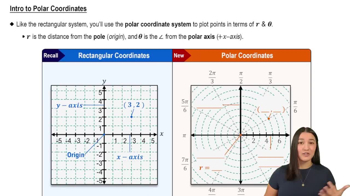
Polar coordinates represent points in the plane using a radius r and an angle θ from the positive x-axis. Understanding how r and θ define a point's position is essential for converting between polar and Cartesian forms.
Recommended video:
05:32
Intro to Polar Coordinates

Conversion Between Polar and Cartesian Coordinates

The relationships x = r cos θ and y = r sin θ allow conversion from polar to Cartesian coordinates. Manipulating these equations helps rewrite polar equations in terms of x and y, facilitating graphing and analysis.
Recommended video:
05:32
Intro to Polar Coordinates

Using Angle Shift Identities in Polar Equations

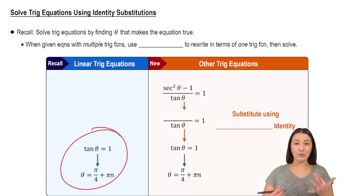
Expressions like r cos(θ − α) can be expanded using trigonometric identities: r cos(θ − α) = r cos θ cos α + r sin θ sin α. This expansion is key to expressing the equation in terms of x and y for Cartesian conversion.
Recommended video:
4:42
Solve Trig Equations Using Identity Substitutions
Related Practice
Textbook Question

Identifying Conic Sections


Complete the squares to identify the conic sections in Exercises 69-76. Find their foci, vertices, centers, and asymptotes (as appropriate). If the curve is a parabola, find its directrix as well.


x² + y² + 4x + 2y = 1

Textbook Question

Identifying Parametric Equations in the Plane


Exercises 1–6 give parametric equations and parameter intervals for the motion of a particle in the xy-plane. Identify the particle’s path by finding a Cartesian equation for it. Graph the Cartesian equation and indicate the direction of motion and the portion traced by the particle.


x = √t, y = 1 − √t, t ≥ 0

Textbook Question

Lengths of Curves


Find the lengths of the curves in Exercises 13–19.


x = 5 cos t − cos 5t, y = 5 sin t − sin 5t, 0 ≤ t ≤ π/2

1
views
Textbook Question

Identifying Parametric Equations in the Plane


Exercises 1–6 give parametric equations and parameter intervals for the motion of a particle in the xy-plane. Identify the particle’s path by finding a Cartesian equation for it. Graph the Cartesian equation and indicate the direction of motion and the portion traced by the particle.


x = 4 cos t, y = 9 sin t, 0 ≤ t ≤ 2π

Textbook Question

Area in Polar Coordinates


Find the areas of the regions in the polar coordinate plane described in Exercises 47–50.


Inside the cardioid r = 2(1 + sin θ) and outside the circle r = 2 sin θ

1
views
Textbook Question

Finding Parametric Equations and Tangent Lines


Find parametric equations for the given curve.


Line through (1,-2) with slope 3