Ch. 11 - Parametric Equations and Polar Coordinates
Hass - Thomas' Calculus 15th Edition
Hass15th EditionThomas' CalculusISBN: 9780137616077Not the one you use?Change textbook
Chapter 11, Problem 11.PE.12a

Finding Parametric Equations and Tangent Lines


Find parametric equations for the given curve.


Line through (1,-2) with slope 3

Verified step by step guidance
1
Recall that a parametric equation for a line can be expressed as \(x = x_0 + at\) and \(y = y_0 + bt\), where \((x_0, y_0)\) is a point on the line and \((a, b)\) is a direction vector parallel to the line.
Identify the given point on the line as \((1, -2)\), so \(x_0 = 1\) and \(y_0 = -2\).
Use the slope of the line, which is 3, to find the direction vector. Since slope \(m = \frac{b}{a} = 3\), you can choose \(a = 1\) and \(b = 3\) for simplicity.
Write the parametric equations using the point and direction vector: \(x = 1 + 1 \cdot t\) and \(y = -2 + 3 \cdot t\).
These parametric equations describe the line passing through \((1, -2)\) with slope 3, where \(t\) is the parameter.

Verified video answer for a similar problem:

This video solution was recommended by our tutors as helpful for the problem above.
Video duration:
1m
Was this helpful?

Key Concepts

Here are the essential concepts you must grasp in order to answer the question correctly.

Parametric Equations

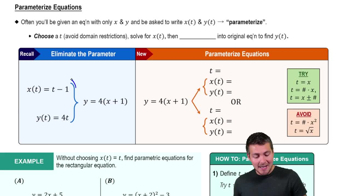
Parametric equations express a curve by defining both x and y coordinates as functions of a third variable, usually t. This allows representation of curves that are difficult to describe with a single function y = f(x). For example, a line can be represented as x = x0 + at and y = y0 + bt, where (x0, y0) is a point on the line and (a, b) relates to the direction.
Recommended video:
Guided course
08:02
Parameterizing Equations

Equation of a Line Using Point-Slope Form

The point-slope form of a line is y - y1 = m(x - x1), where (x1, y1) is a point on the line and m is the slope. This form is useful for quickly writing the equation of a line when a point and slope are known. It can be rearranged or converted into parametric form for further analysis.
Recommended video:
05:13
Slopes of Tangent Lines

Tangent Lines and Their Slopes

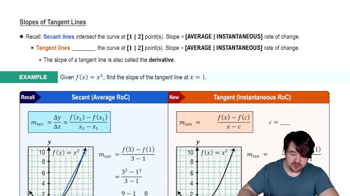
A tangent line to a curve at a point touches the curve without crossing it and has the same slope as the curve at that point. For parametric curves, the slope of the tangent line is found by dy/dx = (dy/dt) / (dx/dt). Understanding tangent lines helps in analyzing the behavior and direction of curves.
Recommended video:
05:13
Slopes of Tangent Lines
Related Practice
Textbook Question

Finding Parametric Equations and Tangent Lines


Find parametric equations for the given curve.


9x² + 4y² = 36

1
views

Textbook Question

Identifying Conic Sections


Complete the squares to identify the conic sections in Exercises 69-76. Find their foci, vertices, centers, and asymptotes (as appropriate). If the curve is a parabola, find its directrix as well.


x² + y² + 4x + 2y = 1

Textbook Question

Identifying Parametric Equations in the Plane


Exercises 1–6 give parametric equations and parameter intervals for the motion of a particle in the xy-plane. Identify the particle’s path by finding a Cartesian equation for it. Graph the Cartesian equation and indicate the direction of motion and the portion traced by the particle.


x = √t, y = 1 − √t, t ≥ 0

Textbook Question

Identifying Parametric Equations in the Plane


Exercises 1–6 give parametric equations and parameter intervals for the motion of a particle in the xy-plane. Identify the particle’s path by finding a Cartesian equation for it. Graph the Cartesian equation and indicate the direction of motion and the portion traced by the particle.


x = 4 cos t, y = 9 sin t, 0 ≤ t ≤ 2π

Textbook Question

Graphing Conic Sections


Find the eccentricities of the ellipses and hyperbolas in Exercises 59–62. Sketch each conic section. Include the foci, vertices, and asymptotes (as appropriate) in your sketch.


5y² − 4x² = 20

Textbook Question

Polar to Cartesian Equations


Sketch the lines in Exercises 23-28. Also, find a Cartesian equation for each line.


r cos (θ − 3π/4) = (√2)/2

1
views