Ch. 11 - Parametric Equations and Polar Coordinates
Hass - Thomas' Calculus 15th Edition
Hass15th EditionThomas' CalculusISBN: 9780137616077Not the one you use?Change textbook
Chapter 11, Problem 11.PE.62

Graphing Conic Sections


Find the eccentricities of the ellipses and hyperbolas in Exercises 59–62. Sketch each conic section. Include the foci, vertices, and asymptotes (as appropriate) in your sketch.


5y² − 4x² = 20

Verified step by step guidance
1
Rewrite the given equation in the standard form of a conic section. Start by dividing both sides of the equation by 20 to isolate the terms: \(\frac{5y^{2}}{20} - \frac{4x^{2}}{20} = 1\) which simplifies to \(\frac{y^{2}}{4} - \frac{x^{2}}{5} = 1\).
Identify the type of conic section from the standard form. Since the equation is of the form \(\frac{y^{2}}{a^{2}} - \frac{x^{2}}{b^{2}} = 1\), it represents a hyperbola that opens vertically (along the y-axis).
Recall the formula for the eccentricity \(e\) of a hyperbola: \(e = \frac{c}{a}\), where \(c^{2} = a^{2} + b^{2}\). Here, \(a^{2} = 4\) and \(b^{2} = 5\). Calculate \(c\) by finding \(c = \sqrt{a^{2} + b^{2}}\).
Determine the coordinates of the vertices and foci. For a hyperbola opening vertically, vertices are at \((0, \pm a)\) and foci at \((0, \pm c)\). Plot these points accordingly.
Find the equations of the asymptotes, which for a vertical hyperbola are given by \(y = \pm \frac{a}{b} x\). Use the values of \(a\) and \(b\) to write these equations and include them in your sketch.

Verified video answer for a similar problem:

This video solution was recommended by our tutors as helpful for the problem above.
Video duration:
4m
Was this helpful?

Key Concepts

Here are the essential concepts you must grasp in order to answer the question correctly.

Conic Sections and Their Standard Forms

Conic sections are curves obtained by intersecting a plane with a double-napped cone, resulting in ellipses, hyperbolas, parabolas, or circles. Each conic has a standard equation form; for example, ellipses and hyperbolas have distinct forms involving squared terms with positive or negative signs. Recognizing and rewriting the given equation into a standard form is essential for identifying the conic type and its properties.
Recommended video:
5:33
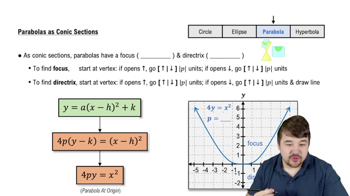
Parabolas as Conic Sections

Eccentricity of Ellipses and Hyperbolas

Eccentricity (e) measures how much a conic deviates from being circular. For ellipses, e ranges between 0 and 1, calculated as the ratio of the distance between foci to the major axis length. For hyperbolas, e is greater than 1, reflecting their open shape. Calculating eccentricity involves using the relationship between the semi-major axis, semi-minor axis, and focal distance.
Recommended video:
6:15
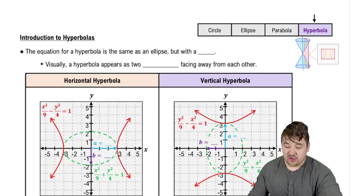
Introduction to Hyperbolas

Graphing Conic Sections: Foci, Vertices, and Asymptotes

Graphing conics requires plotting key features: vertices (points where the conic intersects its principal axis), foci (fixed points defining the conic), and asymptotes (lines that hyperbolas approach at infinity). For ellipses, asymptotes are not present, but for hyperbolas, asymptotes guide the shape. Identifying these elements helps in accurately sketching the conic section.
Recommended video:
5:22
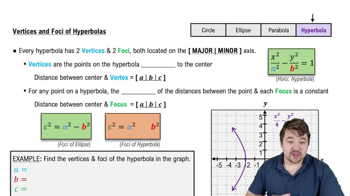
Foci and Vertices of Hyperbolas