Ch. 11 - Parametric Equations and Polar Coordinates
Hass - Thomas' Calculus 15th Edition
Hass15th EditionThomas' CalculusISBN: 9780137616077Not the one you use?Change textbook
Chapter 11, Problem 11.PE.2

Identifying Parametric Equations in the Plane


Exercises 1–6 give parametric equations and parameter intervals for the motion of a particle in the xy-plane. Identify the particle’s path by finding a Cartesian equation for it. Graph the Cartesian equation and indicate the direction of motion and the portion traced by the particle.


x = √t, y = 1 − √t, t ≥ 0

Verified step by step guidance
1
Start with the given parametric equations: \(x = \sqrt{t}\) and \(y = 1 - \sqrt{t}\), where \(t \geq 0\).
Express \(\sqrt{t}\) in terms of \(x\) from the first equation: \(\sqrt{t} = x\).
Substitute \(\sqrt{t} = x\) into the second equation to eliminate the parameter \(t\): \(y = 1 - x\).
Recognize that the Cartesian equation of the path is \(y = 1 - x\), which is a straight line.
Determine the portion of the line traced by the particle by considering the domain of \(t\): since \(t \geq 0\), and \(x = \sqrt{t}\), then \(x \geq 0\). So the particle moves along the line \(y = 1 - x\) for \(x \geq 0\), starting at the point \((0,1)\) and moving in the direction of increasing \(x\).

Verified video answer for a similar problem:

This video solution was recommended by our tutors as helpful for the problem above.
Video duration:
8m
Was this helpful?

Key Concepts

Here are the essential concepts you must grasp in order to answer the question correctly.

Parametric Equations

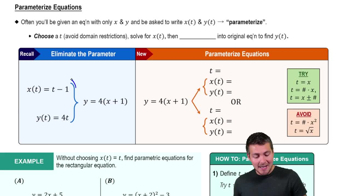
Parametric equations express the coordinates of points on a curve as functions of a parameter, often time (t). Instead of y as a function of x, both x and y depend on t, allowing the description of more complex motions and paths in the plane.
Recommended video:
Guided course
08:02
Parameterizing Equations

Eliminating the Parameter

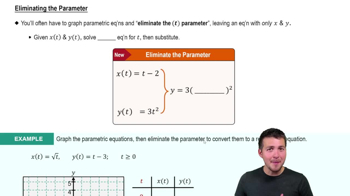
To find the Cartesian equation from parametric equations, solve one equation for the parameter and substitute into the other. This process removes the parameter, yielding a direct relationship between x and y that describes the particle’s path.
Recommended video:
Guided course
05:59
Eliminating the Parameter

Direction and Domain of the Parameter

The parameter interval defines the portion of the curve traced and the direction of motion. Understanding the range of t and how x and y change with t helps determine which part of the Cartesian curve corresponds to the particle’s path and its movement direction.
Recommended video:
Guided course
05:59
Eliminating the Parameter