Ch. 10 - Infinite Sequences and Series
Hass - Thomas' Calculus 15th Edition
Hass15th EditionThomas' CalculusISBN: 9780137616077Not the one you use?Change textbook
Chapter 10, Problem 10.1.123

In Exercises 121–124, determine whether the sequence is monotonic and whether it is bounded.
aₙ = 2ⁿ 3ⁿ / n!

Verified step by step guidance
1
First, write down the given sequence explicitly: \(a_n = \frac{2^n 3^n}{n!} = \frac{(2 \cdot 3)^n}{n!} = \frac{6^n}{n!}\).
To determine if the sequence is monotonic, consider the ratio \(\frac{a_{n+1}}{a_n}\) and analyze whether it is greater than, less than, or equal to 1. Compute this ratio as \(\frac{a_{n+1}}{a_n} = \frac{6^{n+1} / (n+1)!}{6^n / n!} = \frac{6^{n+1}}{6^n} \cdot \frac{n!}{(n+1)!} = \frac{6}{n+1}\).
Analyze the ratio \(\frac{6}{n+1}\): for values of \(n\) where \(\frac{6}{n+1} > 1\), the sequence is increasing; where \(\frac{6}{n+1} < 1\), the sequence is decreasing. This helps identify intervals of monotonicity.
To check if the sequence is bounded, consider the behavior of \(a_n = \frac{6^n}{n!}\) as \(n\) becomes very large. Recall that factorial growth (\(n!\)) eventually outpaces exponential growth (\$6^n\(), which suggests the sequence might approach zero for large \)n$.
Summarize the findings: use the ratio test to determine monotonicity intervals and the growth comparison between \$6^n\( and \)n!$ to conclude about boundedness.

Verified video answer for a similar problem:

This video solution was recommended by our tutors as helpful for the problem above.
Video duration:
13m
Was this helpful?

Key Concepts

Here are the essential concepts you must grasp in order to answer the question correctly.

Monotonic Sequences

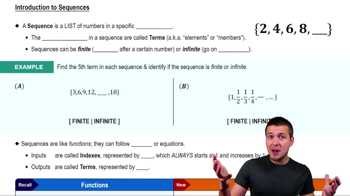
A sequence is monotonic if it is either entirely non-increasing or non-decreasing. To determine monotonicity, compare consecutive terms (aₙ and aₙ₊₁) to see if the sequence consistently increases or decreases. This helps understand the behavior and trend of the sequence over its domain.
Recommended video:
Guided course
8:22
Introduction to Sequences

Bounded Sequences

A sequence is bounded if there exists a real number M such that all terms of the sequence lie within the interval [-M, M]. Checking boundedness involves finding upper and lower limits that the sequence does not exceed, which is crucial for understanding convergence and stability.
Recommended video:
Guided course
8:22
Introduction to Sequences

Factorials and Growth Rates

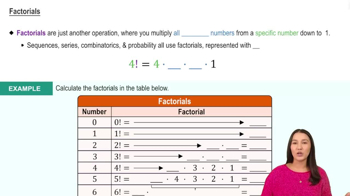
Factorials (n!) grow faster than exponential functions like 2ⁿ or 3ⁿ as n becomes large. Understanding the relative growth rates of factorials versus exponentials is essential to analyze the behavior of the sequence aₙ = (2ⁿ 3ⁿ) / n!, especially when determining limits, monotonicity, and boundedness.
Recommended video:
5:22
Factorials