Ch. 10 - Infinite Sequences and Series
Hass - Thomas' Calculus 15th Edition
Hass15th EditionThomas' CalculusISBN: 9780137616077Not the one you use?Change textbook
Chapter 10, Problem 10.8.33

Finding Taylor and Maclaurin Series
In Exercises 25–34, find the Taylor series generated by f at x = a.
f(x) = cos(2x + π/2),a = π/4

Verified step by step guidance
1
Recall that the Taylor series of a function \( f(x) \) centered at \( x = a \) is given by the formula: \[ f(x) = \sum_{n=0}^{\infty} \frac{f^{(n)}(a)}{n!} (x - a)^n \] where \( f^{(n)}(a) \) is the \( n \)-th derivative of \( f \) evaluated at \( x = a \).
Identify the function and the center: here, \( f(x) = \cos(2x + \frac{\pi}{2}) \) and \( a = \frac{\pi}{4} \). We will need to find the derivatives of \( f \) evaluated at \( x = \frac{\pi}{4} \).
Compute the first few derivatives of \( f(x) \): - \( f(x) = \cos(2x + \frac{\pi}{2}) \) - \( f'(x) = -2 \sin(2x + \frac{\pi}{2}) \) - \( f''(x) = -4 \cos(2x + \frac{\pi}{2}) \) - \( f^{(3)}(x) = 8 \sin(2x + \frac{\pi}{2}) \) - \( f^{(4)}(x) = 16 \cos(2x + \frac{\pi}{2}) \) Notice the pattern in derivatives and coefficients.
Evaluate each derivative at \( x = \frac{\pi}{4} \): Calculate \( f(a), f'(a), f''(a), f^{(3)}(a), f^{(4)}(a) \) by substituting \( x = \frac{\pi}{4} \) into each derivative expression.
Write the Taylor series expansion using the formula: \[ f(x) = \sum_{n=0}^{\infty} \frac{f^{(n)}(a)}{n!} (x - a)^n \] Substitute the values of \( f^{(n)}(a) \) found in the previous step to express the series explicitly.

Verified video answer for a similar problem:

This video solution was recommended by our tutors as helpful for the problem above.
Video duration:
5m
Was this helpful?

Key Concepts

Here are the essential concepts you must grasp in order to answer the question correctly.

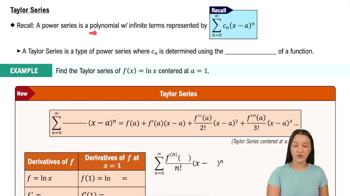
Taylor Series

A Taylor series represents a function as an infinite sum of terms calculated from the derivatives of the function at a single point a. It approximates the function near that point using polynomial terms, where each term involves the nth derivative evaluated at a, multiplied by (x - a)^n and divided by n!.
Recommended video:
08:42
Taylor Series

Maclaurin Series

The Maclaurin series is a special case of the Taylor series centered at a = 0. It expresses a function as an infinite sum of derivatives evaluated at zero, useful for approximating functions near zero. Understanding this helps in comparing and deriving series expansions at different points.
Recommended video:
08:26
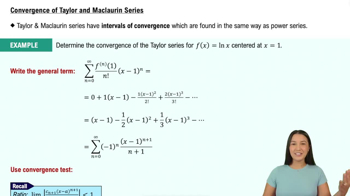
Convergence of Taylor & Maclaurin Series

Derivatives of Trigonometric Functions

Finding the Taylor series for f(x) = cos(2x + π/2) requires computing successive derivatives of the cosine function, applying the chain rule for the inner function 2x + π/2. Recognizing the pattern of derivatives for cosine and sine functions is essential to formulating the series terms correctly.
Recommended video:
06:35
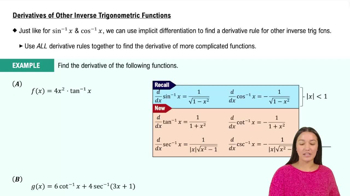
Derivatives of Other Inverse Trigonometric Functions