Ch. 10 - Infinite Sequences and Series
Hass - Thomas' Calculus 15th Edition
Hass15th EditionThomas' CalculusISBN: 9780137616077Not the one you use?Change textbook
Chapter 10, Problem 10.10.37

Use series to evaluate the limits in Exercises 29–40.
37. lim (x → 0) ln(1 + x²) / (1 - cos(x))

Verified step by step guidance
1
Recall the Maclaurin series expansions for the functions involved: \( \ln(1 + x^2) \) and \( \cos(x) \).
Write the series expansion for \( \ln(1 + x^2) \) around \( x = 0 \). Since \( \ln(1 + u) = u - \frac{u^2}{2} + \frac{u^3}{3} - \cdots \), substitute \( u = x^2 \) to get \( \ln(1 + x^2) = x^2 - \frac{x^4}{2} + \frac{x^6}{3} - \cdots \).
Write the series expansion for \( \cos(x) \) around \( x = 0 \): \( \cos(x) = 1 - \frac{x^2}{2} + \frac{x^4}{24} - \cdots \).
Substitute the series expansions into the original limit expression: \( \frac{\ln(1 + x^2)}{1 - \cos(x)} = \frac{x^2 - \frac{x^4}{2} + \cdots}{1 - \left(1 - \frac{x^2}{2} + \frac{x^4}{24} - \cdots \right)} \).
Simplify the denominator: \( 1 - \cos(x) = \frac{x^2}{2} - \frac{x^4}{24} + \cdots \). Then, divide the numerator series by the denominator series, and identify the leading terms to find the limit as \( x \to 0 \).

Verified video answer for a similar problem:

This video solution was recommended by our tutors as helpful for the problem above.
Video duration:
8m
Was this helpful?

Key Concepts

Here are the essential concepts you must grasp in order to answer the question correctly.

Taylor and Maclaurin Series

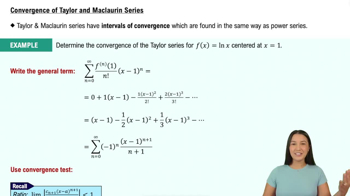
Taylor and Maclaurin series express functions as infinite sums of powers of (x - a) or x, respectively. They allow approximation of functions near a point, making it easier to analyze limits, derivatives, and integrals. For example, ln(1 + x²) and cos(x) can be expanded into power series around x = 0.
Recommended video:
08:26
Convergence of Taylor & Maclaurin Series

Limit Evaluation Using Series Expansion

When direct substitution in a limit leads to an indeterminate form, series expansions help by approximating numerator and denominator with polynomials. This simplification often reveals the limit's value by canceling terms or comparing leading powers, especially useful for limits involving logarithmic and trigonometric functions.
Recommended video:
06:45
Intro to Series: Partial Sums

Behavior of Logarithmic and Trigonometric Functions Near Zero

Understanding how ln(1 + x²) and cos(x) behave near zero is crucial. ln(1 + x²) behaves like x² for small x, while cos(x) approximates 1 - x²/2. Recognizing these approximations helps simplify the limit expression and identify dominant terms in numerator and denominator.
Recommended video:
6:04
Introduction to Trigonometric Functions