Ch. 10 - Infinite Sequences and Series
Hass - Thomas' Calculus 15th Edition
Hass15th EditionThomas' CalculusISBN: 9780137616077Not the one you use?Change textbook
Chapter 10, Problem 10.3.2

Applying the Integral Test
Use the Integral Test to determine if the series in Exercises 1–12 converge or diverge. Be sure to check that the conditions of the Integral Test are satisfied.
∑ (from n = 1 to ∞) 1 / n⁰·²

Verified step by step guidance
1
Identify the series given: \( \sum_{n=1}^{\infty} \frac{1}{n^{0.2}} \). We want to determine if this series converges or diverges using the Integral Test.
Recall the Integral Test conditions: The function \( f(x) = \frac{1}{x^{0.2}} \) must be positive, continuous, and decreasing for \( x \geq 1 \). Verify these conditions for \( f(x) \).
Set up the improper integral corresponding to the series: \( \int_1^{\infty} \frac{1}{x^{0.2}} \, dx \). This integral will help determine the behavior of the series.
Evaluate the integral \( \int_1^{\infty} x^{-0.2} \, dx \) by finding the antiderivative of \( x^{-0.2} \), which involves increasing the exponent by 1 and dividing by the new exponent.
Analyze the limit of the integral as the upper bound approaches infinity. If the integral converges (has a finite value), then the series converges; if it diverges (goes to infinity), then the series diverges.

Verified video answer for a similar problem:

This video solution was recommended by our tutors as helpful for the problem above.
Video duration:
4m
Was this helpful?

Key Concepts

Here are the essential concepts you must grasp in order to answer the question correctly.

Integral Test for Convergence

The Integral Test determines the convergence or divergence of an infinite series by comparing it to an improper integral. If the function f(x) corresponding to the series terms is positive, continuous, and decreasing for x ≥ 1, then the series ∑ f(n) and the integral ∫ f(x) dx from 1 to ∞ either both converge or both diverge.
Recommended video:
07:51
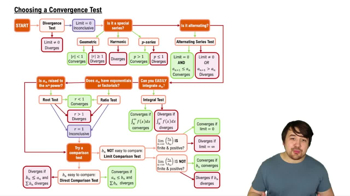
Choosing a Convergence Test

Conditions for Applying the Integral Test

To apply the Integral Test, the function f(x) must be positive, continuous, and decreasing on the interval [1, ∞). Verifying these conditions ensures the test is valid. For the series ∑ 1/n^0.2, checking these properties for f(x) = 1/x^0.2 is essential before proceeding.
Recommended video:
07:25
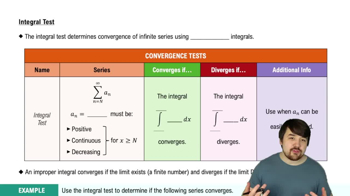
Integral Test

Behavior of p-Series and Improper Integrals

The series ∑ 1/n^p is known as a p-series, which converges if p > 1 and diverges otherwise. Similarly, the integral ∫ 1/x^p dx from 1 to ∞ converges if p > 1. Understanding this helps quickly determine the convergence of the given series with p = 0.2, which is less than 1, indicating divergence.
Recommended video:
11:11
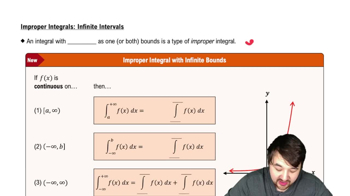
Improper Integrals: Infinite Intervals