Estimate the value of ∑ (from n=2 to ∞) (1 / (n² + 4)) to within 0.1 of its exact value.
Ch. 10 - Infinite Sequences and Series
Chapter 10, Problem 10.2.48
Find the sum of each series in Exercises 45–52.
∑ (from n = 1 to ∞) [ (2n + 1) / (n²(n + 1)²) ]
Verified step by step guidance1
Start by examining the general term of the series: \(\frac{2n + 1}{n^{2}(n + 1)^{2}}\). Our goal is to express this term in a form that allows us to use telescoping or known series sums.
Try to decompose the term into partial fractions. Since the denominator is \(n^{2}(n + 1)^{2}\), consider expressing the term as a sum of fractions of the form \(\frac{A}{n} + \frac{B}{n^{2}} + \frac{C}{n + 1} + \frac{D}{(n + 1)^{2}}\).
Set up the equation: \(\frac{2n + 1}{n^{2}(n + 1)^{2}} = \frac{A}{n} + \frac{B}{n^{2}} + \frac{C}{n + 1} + \frac{D}{(n + 1)^{2}}\). Multiply both sides by \(n^{2}(n + 1)^{2}\) to clear denominators and solve for constants \(A\), \(B\), \(C\), and \(D\) by equating coefficients of powers of \(n\).
Once the partial fractions are found, rewrite the series as a sum of simpler series: \(\sum_{n=1}^{\infty} \left( \frac{A}{n} + \frac{B}{n^{2}} + \frac{C}{n + 1} + \frac{D}{(n + 1)^{2}} \right)\). This will allow you to separate the original series into sums that are easier to evaluate or telescope.
Evaluate the sums by recognizing telescoping patterns or using known series results such as the Riemann zeta function for \(\sum \frac{1}{n^{2}}\). Combine the results carefully to find the sum of the original series.

Verified video answer for a similar problem:
This video solution was recommended by our tutors as helpful for the problem above.
Video duration:
13mWas this helpful?
Key Concepts
Here are the essential concepts you must grasp in order to answer the question correctly.
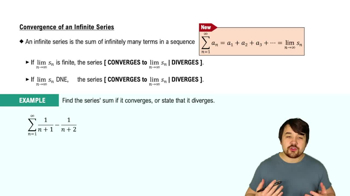
Infinite Series and Convergence
An infinite series is the sum of infinitely many terms. To find its sum, the series must converge, meaning its partial sums approach a finite limit. Understanding convergence tests helps determine if the series sum exists.
Recommended video:
Convergence of an Infinite Series
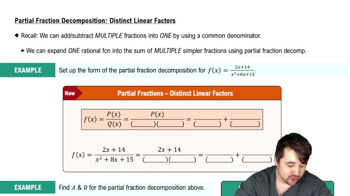
Partial Fraction Decomposition
Partial fraction decomposition breaks a complex rational expression into simpler fractions. This technique simplifies terms in the series, making it easier to identify telescoping patterns or to sum the series explicitly.
Recommended video:
Partial Fraction Decomposition: Distinct Linear Factors
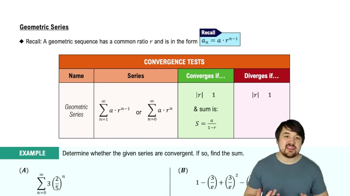
Telescoping Series
A telescoping series is one where many terms cancel out when the series is expanded. Recognizing this pattern allows simplification of the sum to just a few terms, facilitating the calculation of the infinite sum.
Recommended video:
Geometric Series
Related Practice
Textbook Question
Textbook Question
Finding Taylor Polynomials
In Exercises 1–10, find the Taylor polynomials of orders 0, 1, 2, and 3 generated by f at a.
f(x) = √(1 − x),a = 0
Textbook Question
In Exercises 15–22, determine if the geometric series converges or diverges. If a series converges, find its sum.
1 − (2/e) + (2/e)² − (2/e)³ + (2/e)⁴ − …
1
views
Textbook Question
Absolute and Conditional Convergence
Which of the series in Exercises 15–48 converge absolutely, which converge, and which diverge? Give reasons for your answers.
∑ (from n = 1 to ∞) [(-1)ⁿ (√(n² + n) − n)]
1
views

Textbook Question
In Exercises 121–124, determine whether the sequence is monotonic and whether it is bounded.
aₙ = 2ⁿ 3ⁿ / n!
1
views
Textbook Question
Finding Taylor and Maclaurin Series
In Exercises 25–34, find the Taylor series generated by f at x = a.
f(x) = cos(2x + π/2),a = π/4