
Ch. 10 - Infinite Sequences and Series
Hass - Thomas' Calculus 15th Edition
Hass15th EditionThomas' CalculusISBN: 9780137616077Not the one you use?Change textbook
Chapter 10, Problem 10.4.8

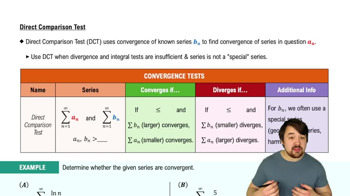
Direct Comparison Test
In Exercises 1–8, use the Direct Comparison Test to determine if each series converges or diverges.
∑ (from n=1 to ∞) (√n + 1) / (√(n² + 3))

Verified step by step guidance
1
Identify the given series: \( \sum_{n=1}^{\infty} \frac{\sqrt{n} + 1}{\sqrt{n^2 + 3}} \). We want to determine if it converges or diverges using the Direct Comparison Test.
Simplify the general term to understand its behavior for large \( n \). Notice that \( \sqrt{n^2 + 3} \) behaves like \( n \) as \( n \to \infty \), so the term roughly behaves like \( \frac{\sqrt{n} + 1}{n} \).
Split the term into two parts: \( \frac{\sqrt{n}}{n} + \frac{1}{n} = \frac{1}{\sqrt{n}} + \frac{1}{n} \). This helps us compare with known series.
Choose appropriate comparison series: compare \( \frac{1}{\sqrt{n}} \) with \( \sum \frac{1}{n^{1/2}} \) and \( \frac{1}{n} \) with the harmonic series \( \sum \frac{1}{n} \). Recall that \( \sum \frac{1}{n^{p}} \) converges if and only if \( p > 1 \).
Use the Direct Comparison Test by comparing the original term to these simpler terms. Since \( \frac{1}{\sqrt{n}} \) diverges and dominates the behavior, conclude about the convergence or divergence of the original series accordingly.

Verified video answer for a similar problem:

This video solution was recommended by our tutors as helpful for the problem above.
Video duration:
4m
Was this helpful?

Key Concepts

Here are the essential concepts you must grasp in order to answer the question correctly.

Direct Comparison Test

The Direct Comparison Test determines the convergence or divergence of a series by comparing it to another series with known behavior. If the terms of the given series are less than or equal to the terms of a convergent series, it also converges. Conversely, if the terms are greater than or equal to those of a divergent series, it diverges.
Recommended video:
09:25
Direct Comparison Test

Behavior of Series Terms for Large n

Analyzing the behavior of the series terms as n approaches infinity helps simplify complex expressions. For example, dominant terms in numerator and denominator guide the comparison to simpler series like p-series or geometric series, facilitating the application of convergence tests.
Recommended video:
06:45
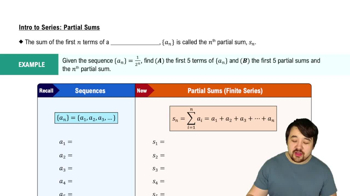
Intro to Series: Partial Sums

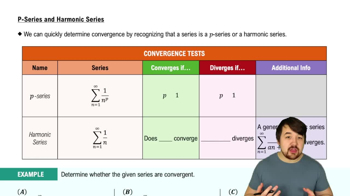
p-Series and Their Convergence

A p-series has the form ∑ 1/n^p and converges if p > 1, diverging otherwise. Recognizing or approximating a given series to a p-series allows for straightforward conclusions about convergence, which is essential when using the Direct Comparison Test.
Recommended video:
04:30
P-Series and Harmonic Series