Ch.12 - Parametric and Polar Curves
Briggs - Calculus: Early Transcendentals 3rd Edition
Briggs3rd EditionCalculus: Early TranscendentalsISBN: 9780136847243Not the one you use?Change textbook
Chapter 12, Problem 12.4.52

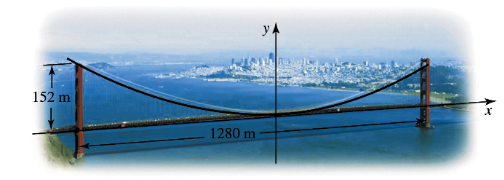
Golden Gate Bridge Completed in 1937, San Francisco’s Golden Gate Bridge is 2.7 km long and weighs about 890,000 tons. The length of the span between the two central towers is 1280 m; the towers themselves extend 152 m above the roadway. The cables that support the deck of the bridge between the two towers hang in a parabola (see figure). Assuming the origin is midway between the towers on the deck of the bridge, find an equation that describes the cables. How long is a guy wire that hangs vertically from the cables to the roadway 500 m from the center of the bridge? 
img

Verified step by step guidance
1
Step 1: Define the coordinate system and variables. Place the origin at the midpoint between the two towers on the roadway, so the x-axis runs along the bridge deck and the y-axis measures the height of the cables above the roadway. The two towers are located at \(x = -640\) m and \(x = 640\) m (since the span between towers is 1280 m). The cable reaches its lowest point at the origin, so \(y(0) = 0\).
Step 2: Model the cable as a parabola. The general form of a parabola opening upwards with vertex at the origin is \(y = a x^{2}\). We know the cable height at the towers is 152 m, so substitute \(x = 640\) and \(y = 152\) to find \(a\): \(152 = a (640)^{2}\).
Step 3: Solve for the coefficient \(a\) by rearranging the equation: \(a = \frac{152}{640^{2}}\). This gives the specific equation of the parabola describing the cable: \(y = a x^{2}\).
Step 4: To find the length of the guy wire hanging vertically from the cable to the roadway at \(x = 500\) m, calculate the height of the cable at \(x = 500\) by substituting into the parabola equation: \(y(500) = a (500)^{2}\).
Step 5: The length of the guy wire is simply the vertical distance from the cable to the roadway, which is \(y(500)\). This value represents how far the wire hangs down from the cable to the deck at 500 m from the center.

Verified video answer for a similar problem:

This video solution was recommended by our tutors as helpful for the problem above.
Video duration:
4m
Was this helpful?

Key Concepts

Here are the essential concepts you must grasp in order to answer the question correctly.

Parabolic Functions and Their Equations

A parabolic function is a quadratic function that graphs as a parabola. In this problem, the cable's shape is modeled by a parabola, which can be expressed as y = ax^2 + bx + c. Using given points, such as the height of the towers and the span between them, allows us to find the specific equation describing the cable's curve.
Recommended video:
Guided course
08:02
Parameterizing Equations

Coordinate System and Symmetry

Placing the origin at the midpoint between the towers simplifies the problem by exploiting symmetry. The parabola is symmetric about the y-axis, so the equation has no linear term (bx = 0). This helps reduce the number of unknowns and makes it easier to use the given dimensions to find the parabola's equation.
Recommended video:
05:32
Intro to Polar Coordinates

Evaluating the Parabola to Find Vertical Distances

Once the parabola's equation is determined, substituting a specific x-value (distance from the center) gives the cable's height at that point. The vertical guy wire length is the difference between the cable height and the roadway (y=0). This application of function evaluation connects the model to the physical measurement needed.
Recommended video:
04:19
Finding Global Extrema (Extreme Value Theorem) Example 3