
Golden Gate Bridge Completed in 1937, San Francisco’s Golden Gate Bridge is 2.7 km long and weighs about 890,000 tons. The length of the span between the two central towers is 1280 m; the towers themselves extend 152 m above the roadway. The cables that support the deck of the bridge between the two towers hang in a parabola (see figure). Assuming the origin is midway between the towers on the deck of the bridge, find an equation that describes the cables. How long is a guy wire that hangs vertically from the cables to the roadway 500 m from the center of the bridge?
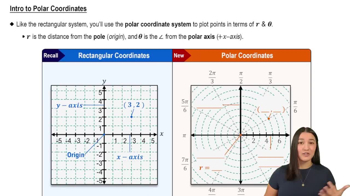
Write the equations that are used to express a point with polar coordinates (r, θ) in Cartesian coordinates.
Verified step by step guidance
Verified video answer for a similar problem:
Key Concepts
Polar Coordinates
Cartesian Coordinates
Conversion Formulas between Polar and Cartesian Coordinates
31–38. Equations of parabolas Find an equation of the following parabolas. Unless otherwise specified, assume the vertex is at the origin.
A parabola symmetric about the y-axis that passes through the point (2, -6)
31–38. Equations of parabolas Find an equation of the following parabolas. Unless otherwise specified, assume the vertex is at the origin.
41–44. Intersection points and area Find all the intersection points of the following curves. Find the area of the entire region that lies within both curves
r = 3 sin θ and r = 3 cos θ
63–74. Arc length of polar curves Find the length of the following polar curves.
The spiral r = θ², for 0 ≤ θ ≤ 2π
39–50. Equations of ellipses and hyperbolas Find an equation of the following ellipses and hyperbolas, assuming the center is at the origin.
A hyperbola with vertices (±2, 0) and asymptotes y = ±3x/2
