
Golden Gate Bridge Completed in 1937, San Francisco’s Golden Gate Bridge is 2.7 km long and weighs about 890,000 tons. The length of the span between the two central towers is 1280 m; the towers themselves extend 152 m above the roadway. The cables that support the deck of the bridge between the two towers hang in a parabola (see figure). Assuming the origin is midway between the towers on the deck of the bridge, find an equation that describes the cables. How long is a guy wire that hangs vertically from the cables to the roadway 500 m from the center of the bridge?
Ch.12 - Parametric and Polar Curves
Briggs3rd EditionCalculus: Early TranscendentalsISBN: 9780136847243Not the one you use?Change textbook
Chapter 12, Problem 12.3.41
41–44. Intersection points and area Find all the intersection points of the following curves. Find the area of the entire region that lies within both curves
r = 3 sin θ and r = 3 cos θ
Verified step by step guidance1
Identify the curves given in polar coordinates: \(r = 3 \sin \theta\) and \(r = 3 \cos \theta\). These represent two circles in the polar plane.
To find the intersection points, set the two equations equal to each other: \(3 \sin \theta = 3 \cos \theta\). Simplify this to \(\sin \theta = \cos \theta\).
Solve the equation \(\sin \theta = \cos \theta\) for \(\theta\). This occurs when \(\tan \theta = 1\), so \(\theta = \frac{\pi}{4}\) and also consider the periodicity of tangent to find all relevant solutions within \([0, 2\pi)\).
Find the corresponding \(r\) values at the intersection points by substituting \(\theta\) back into either \(r = 3 \sin \theta\) or \(r = 3 \cos \theta\).
To find the area of the region inside both curves, set up the integral for the area common to both. The area enclosed by a polar curve \(r(\theta)\) from \(\alpha\) to \(\beta\) is given by \(\frac{1}{2} \int_{\alpha}^{\beta} r(\theta)^2 \, d\theta\). Determine the limits of integration by analyzing where one curve lies inside the other, then compute the integral of the minimum of the two \(r^2\) values over the appropriate intervals.

Verified video answer for a similar problem:
This video solution was recommended by our tutors as helpful for the problem above.
Video duration:
4mWas this helpful?
Key Concepts
Here are the essential concepts you must grasp in order to answer the question correctly.
Polar Coordinates and Graphing
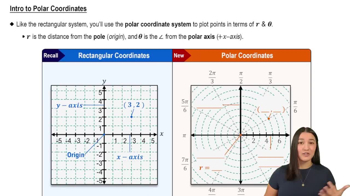
Polar coordinates represent points using a radius and an angle (r, θ), differing from Cartesian coordinates. Understanding how to plot and interpret curves like r = 3 sin θ and r = 3 cos θ is essential for visualizing their shapes and intersection points.
Recommended video:
Intro to Polar Coordinates
Finding Intersection Points in Polar Coordinates
To find intersections of polar curves, set their equations equal and solve for θ and r. This involves equating r-values and considering the periodic nature of trigonometric functions to identify all points where the curves meet.
Recommended video:
Intro to Polar Coordinates
Area Calculation Between Polar Curves
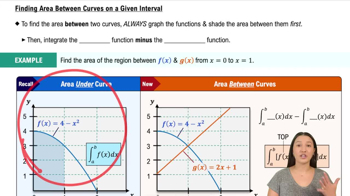
The area enclosed by polar curves is found using the integral formula (1/2)∫(r(θ))^2 dθ. For regions bounded by two curves, the area is the integral of the difference of their squared radii over the interval between intersection points.
Recommended video:
Finding Area Between Curves on a Given Interval
Related Practice
Textbook Question
Textbook Question
31–38. Equations of parabolas Find an equation of the following parabolas. Unless otherwise specified, assume the vertex is at the origin.
A parabola symmetric about the y-axis that passes through the point (2, -6)
Textbook Question
Write the equations that are used to express a point with polar coordinates (r, θ) in Cartesian coordinates.
1
views
Textbook Question
31–38. Equations of parabolas Find an equation of the following parabolas. Unless otherwise specified, assume the vertex is at the origin.
Textbook Question
63–74. Arc length of polar curves Find the length of the following polar curves.
The spiral r = θ², for 0 ≤ θ ≤ 2π
Textbook Question
102–104. Spirals Graph the following spirals. Indicate the direction in which the spiral is generated as θ increases, where θ>0. Let a=1 and a=−1.
Spiral of Archimedes: r = aθ
1
views
