
Ch.12 - Parametric and Polar Curves
Briggs - Calculus: Early Transcendentals 3rd Edition
Briggs3rd EditionCalculus: Early TranscendentalsISBN: 9780136847243Not the one you use?Change textbook
Chapter 12, Problem 12.2.26

25–30. Converting coordinates Express the following polar coordinates in Cartesian coordinates.


(1, 2π/3)

Verified step by step guidance
1
Recall the formulas to convert polar coordinates \((r, \theta)\) to Cartesian coordinates \((x, y)\): \(x = r \cos(\theta)\) \(y = r \sin(\theta)\)
Identify the given polar coordinates: \(r = 1\) \(\theta = \frac{2\pi}{3}\)
Substitute the values into the formulas: \(x = 1 \times \cos\left(\frac{2\pi}{3}\right)\) \(y = 1 \times \sin\left(\frac{2\pi}{3}\right)\)
Evaluate the trigonometric functions \(\cos\left(\frac{2\pi}{3}\right)\) and \(\sin\left(\frac{2\pi}{3}\right)\) using the unit circle or known values.
Write the Cartesian coordinates as the ordered pair \((x, y)\) using the evaluated values from the previous step.

Verified video answer for a similar problem:

This video solution was recommended by our tutors as helpful for the problem above.
Video duration:
1m
Was this helpful?

Key Concepts

Here are the essential concepts you must grasp in order to answer the question correctly.

Polar Coordinates

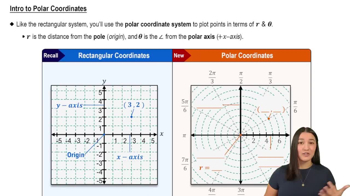
Polar coordinates represent a point in the plane using a radius and an angle, denoted as (r, θ), where r is the distance from the origin and θ is the angle measured from the positive x-axis. This system is useful for describing points in circular or rotational contexts.
Recommended video:
05:32
Intro to Polar Coordinates

Conversion Formulas from Polar to Cartesian Coordinates

To convert polar coordinates (r, θ) to Cartesian coordinates (x, y), use the formulas x = r cos(θ) and y = r sin(θ). These formulas translate the radius and angle into horizontal and vertical distances on the Cartesian plane.
Recommended video:
05:32
Intro to Polar Coordinates

Trigonometric Functions and Angle Measurement

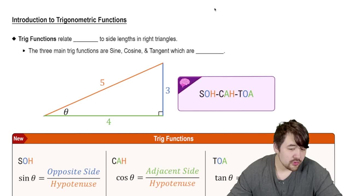
Understanding sine and cosine functions is essential for conversion, as they relate angles to ratios of sides in right triangles. Angles in radians, like 2π/3, must be interpreted correctly to find accurate x and y values.
Recommended video:
6:04
Introduction to Trigonometric Functions
Related Practice
Textbook Question

Golden Gate Bridge Completed in 1937, San Francisco’s Golden Gate Bridge is 2.7 km long and weighs about 890,000 tons. The length of the span between the two central towers is 1280 m; the towers themselves extend 152 m above the roadway. The cables that support the deck of the bridge between the two towers hang in a parabola (see figure). Assuming the origin is midway between the towers on the deck of the bridge, find an equation that describes the cables. How long is a guy wire that hangs vertically from the cables to the roadway 500 m from the center of the bridge? 

Textbook Question

31–38. Equations of parabolas Find an equation of the following parabolas. Unless otherwise specified, assume the vertex is at the origin.

A parabola symmetric about the y-axis that passes through the point (2, -6)

Textbook Question

84. Arc length for polar curves: Prove that the length of the curve r = f(θ) for α ≤ θ ≤ β is

L = ∫(α to β) √(f(θ)² + f'(θ)²) dθ.

Textbook Question

15–30. Working with parametric equations Consider the following parametric equations.

a. Eliminate the parameter to obtain an equation in x and y.

b. Describe the curve and indicate the positive orientation.


x = √t + 4, y = 3√t; 0 ≤ t ≤ 16

Textbook Question

45–60. Areas of regions Find the area of the following regions.


The region inside the curve r = √(cos θ) and inside the circle r = 1/√2 in the first quadrant

1
views
Textbook Question

39–50. Equations of ellipses and hyperbolas Find an equation of the following ellipses and hyperbolas, assuming the center is at the origin. 

A hyperbola with vertices (±2, 0) and asymptotes y = ±3x/2