Ch.12 - Parametric and Polar Curves
Briggs - Calculus: Early Transcendentals 3rd Edition
Briggs3rd EditionCalculus: Early TranscendentalsISBN: 9780136847243Not the one you use?Change textbook
Chapter 12, Problem 12.1.17

15–30. Working with parametric equations Consider the following parametric equations.
a. Eliminate the parameter to obtain an equation in x and y.
b. Describe the curve and indicate the positive orientation.


x = √t + 4, y = 3√t; 0 ≤ t ≤ 16

Verified step by step guidance
1
Identify the given parametric equations: \(x = \sqrt{t} + 4\) and \(y = 3\sqrt{t}\) with the parameter range \(0 \leq t \leq 16\).
Express \(\sqrt{t}\) from one of the equations to eliminate the parameter. For example, from \(y = 3\sqrt{t}\), solve for \(\sqrt{t}\): \(\sqrt{t} = \frac{y}{3}\).
Substitute \(\sqrt{t} = \frac{y}{3}\) into the equation for \(x\): \(x = \frac{y}{3} + 4\).
Rearrange the equation to express \(y\) in terms of \(x\): multiply both sides by 3 and isolate \(y\) to get \(y = 3(x - 4)\), which is the Cartesian equation of the curve.
To describe the curve, recognize that it is a straight line with slope 3 and y-intercept at \(y = -12\). The parameter \(t\) increases from 0 to 16, so \(\sqrt{t}\) increases from 0 to 4, meaning \(x\) increases from 4 to 8 and \(y\) increases from 0 to 12. This indicates the positive orientation is from the point \((4,0)\) to \((8,12)\) along the line.

Verified video answer for a similar problem:

This video solution was recommended by our tutors as helpful for the problem above.
Video duration:
3m
Was this helpful?

Key Concepts

Here are the essential concepts you must grasp in order to answer the question correctly.

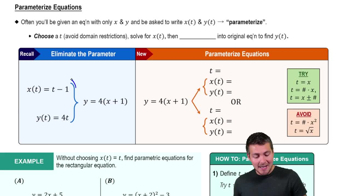
Parametric Equations

Parametric equations express the coordinates of points on a curve as functions of a parameter, often denoted as t. Instead of y as a function of x, both x and y depend on t, allowing the description of more complex curves and motions.
Recommended video:
Guided course
08:02
Parameterizing Equations

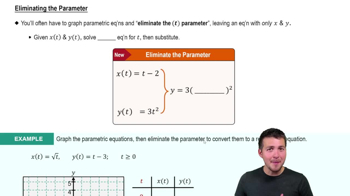
Eliminating the Parameter

Eliminating the parameter involves manipulating the parametric equations to remove t, resulting in a direct relationship between x and y. This process helps to identify the Cartesian equation of the curve, making it easier to analyze its shape.
Recommended video:
Guided course
05:59
Eliminating the Parameter

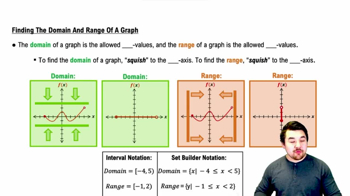
Curve Orientation and Domain

The orientation of a parametric curve is determined by the direction in which the parameter t increases. Understanding the domain of t is essential to describe the portion of the curve traced and to indicate the positive direction along the curve.
Recommended video:
5:10
Finding the Domain and Range of a Graph
Related Practice
Textbook Question

25–30. Converting coordinates Express the following polar coordinates in Cartesian coordinates.


(1, 2π/3)

1
views

Textbook Question

84. Arc length for polar curves: Prove that the length of the curve r = f(θ) for α ≤ θ ≤ β is

L = ∫(α to β) √(f(θ)² + f'(θ)²) dθ.

Textbook Question

77–80. Slopes of tangent lines Find all points at which the following curves have the given slope.


x = 2 + √t, y = 2 - 4t; slope = -8

Textbook Question

45–60. Areas of regions Find the area of the following regions.


The region inside the curve r = √(cos θ) and inside the circle r = 1/√2 in the first quadrant

1
views
Textbook Question

13–30. Graphing conic sections Determine whether the following equations describe a parabola, an ellipse, or a hyperbola, and then sketch a graph of the curve. For each parabola, specify the location of the focus and the equation of the directrix; for each ellipse, label the coordinates of the vertices and foci, and find the lengths of the major and minor axes; for each hyperbola, label the coordinates of the vertices and foci, and find the equations of the asymptotes.


10x² - 7y² = 140

1
views
Textbook Question

53–56. Circular motion Find parametric equations that describe the circular path of the following objects. For Exercises 53–55, assume (x, y) denotes the position of the object relative to the origin at the center of the circle. Use the units of time specified in the problem. There are many ways to describe any circle.


The tip of the 15-inch second hand of a clock completes one revolution in 60 seconds.

1
views