Ch.12 - Parametric and Polar Curves
Briggs - Calculus: Early Transcendentals 3rd Edition
Briggs3rd EditionCalculus: Early TranscendentalsISBN: 9780136847243Not the one you use?Change textbook
Chapter 12, Problem 12.4.30

13–30. Graphing conic sections Determine whether the following equations describe a parabola, an ellipse, or a hyperbola, and then sketch a graph of the curve. For each parabola, specify the location of the focus and the equation of the directrix; for each ellipse, label the coordinates of the vertices and foci, and find the lengths of the major and minor axes; for each hyperbola, label the coordinates of the vertices and foci, and find the equations of the asymptotes.


10x² - 7y² = 140

Verified step by step guidance
1
Rewrite the given equation in the standard form of a conic section by dividing both sides by 140 to normalize it: \(\frac{10x^{2}}{140} - \frac{7y^{2}}{140} = 1\).
Simplify the fractions to get \(\frac{x^{2}}{14} - \frac{y^{2}}{20} = 1\).
Recognize the form of the equation: since it is of the form \(\frac{x^{2}}{a^{2}} - \frac{y^{2}}{b^{2}} = 1\), this represents a hyperbola centered at the origin with the transverse axis along the x-axis.
Identify the values \(a^{2} = 14\) and \(b^{2} = 20\). Use these to find the vertices at \((\pm a, 0)\), which are \((\pm \sqrt{14}, 0)\).
Calculate the foci using \(c^{2} = a^{2} + b^{2}\), so \(c = \sqrt{14 + 20} = \sqrt{34}\). The foci are at \((\pm c, 0)\). Then, find the equations of the asymptotes, which are \(y = \pm \frac{b}{a} x = \pm \frac{\sqrt{20}}{\sqrt{14}} x\).

Verified video answer for a similar problem:

This video solution was recommended by our tutors as helpful for the problem above.
Video duration:
4m
Was this helpful?

Key Concepts

Here are the essential concepts you must grasp in order to answer the question correctly.

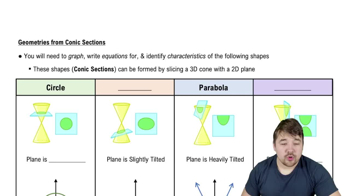
Identification of Conic Sections from General Equations

Conic sections are curves obtained by intersecting a plane with a double-napped cone. The general second-degree equation Ax² + By² + Cx + Dy + E = 0 can represent a parabola, ellipse, or hyperbola depending on the signs and values of A and B. If A and B have the same sign and are unequal, the curve is an ellipse; if one is zero, it is a parabola; if they have opposite signs, it is a hyperbola.
Recommended video:
3:08
Geometries from Conic Sections

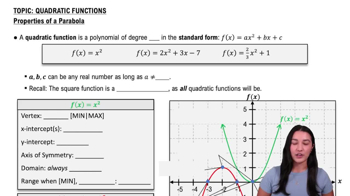
Properties and Features of Parabolas, Ellipses, and Hyperbolas

Each conic section has unique geometric features: parabolas have a focus and directrix defining their shape; ellipses have two foci and vertices with major and minor axes; hyperbolas have two branches with vertices, foci, and asymptotes. Understanding these properties helps in labeling key points and sketching the graph accurately.
Recommended video:
7:42
Properties of Parabolas

Graphing and Analyzing Conic Sections

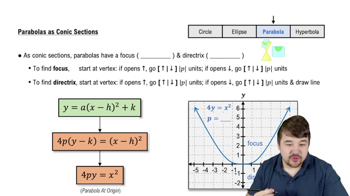
To graph conics, rewrite the equation in standard form by completing the square if necessary. For ellipses and hyperbolas, calculate vertices, foci, and axes lengths or asymptote equations. For parabolas, find the focus and directrix from the standard form. This process enables precise plotting and understanding of the curve's shape.
Recommended video:
5:33
Parabolas as Conic Sections
Related Practice
Textbook Question

84. Arc length for polar curves: Prove that the length of the curve r = f(θ) for α ≤ θ ≤ β is

L = ∫(α to β) √(f(θ)² + f'(θ)²) dθ.

Textbook Question

77–80. Slopes of tangent lines Find all points at which the following curves have the given slope.


x = 2 + √t, y = 2 - 4t; slope = -8

Textbook Question

57–64. Graphing polar curves Graph the following equations. Use a graphing utility to check your work and produce a final graph.


r = sin 3θ

Textbook Question

13–30. Graphing conic sections Determine whether the following equations describe a parabola, an ellipse, or a hyperbola, and then sketch a graph of the curve. For each parabola, specify the location of the focus and the equation of the directrix; for each ellipse, label the coordinates of the vertices and foci, and find the lengths of the major and minor axes; for each hyperbola, label the coordinates of the vertices and foci, and find the equations of the asymptotes.


25y² - 4x² = 100

1
views
Textbook Question

15–30. Working with parametric equations Consider the following parametric equations.

a. Eliminate the parameter to obtain an equation in x and y.

b. Describe the curve and indicate the positive orientation.


x = √t + 4, y = 3√t; 0 ≤ t ≤ 16

Textbook Question

53–56. Circular motion Find parametric equations that describe the circular path of the following objects. For Exercises 53–55, assume (x, y) denotes the position of the object relative to the origin at the center of the circle. Use the units of time specified in the problem. There are many ways to describe any circle.


The tip of the 15-inch second hand of a clock completes one revolution in 60 seconds.

1
views