
Textbook Question
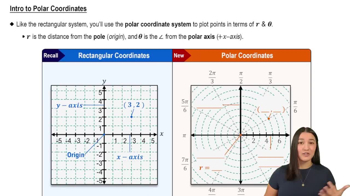
25–30. Converting coordinates Express the following polar coordinates in Cartesian coordinates.
(1, 2π/3)
1
views

 Verified step by step guidance
 05:32
05:32
 06:29 05:32
25–30. Converting coordinates Express the following polar coordinates in Cartesian coordinates.
(1, 2π/3)
15–30. Working with parametric equations Consider the following parametric equations.
a. Eliminate the parameter to obtain an equation in x and y.
b. Describe the curve and indicate the positive orientation.
x = √t + 4, y = 3√t; 0 ≤ t ≤ 16
45–60. Areas of regions Find the area of the following regions.
The region inside the curve r = √(cos θ) and inside the circle r = 1/√2 in the first quadrant
39–50. Equations of ellipses and hyperbolas Find an equation of the following ellipses and hyperbolas, assuming the center is at the origin.
A hyperbola with vertices (±2, 0) and asymptotes y = ±3x/2
13–30. Graphing conic sections Determine whether the following equations describe a parabola, an ellipse, or a hyperbola, and then sketch a graph of the curve. For each parabola, specify the location of the focus and the equation of the directrix; for each ellipse, label the coordinates of the vertices and foci, and find the lengths of the major and minor axes; for each hyperbola, label the coordinates of the vertices and foci, and find the equations of the asymptotes.
10x² - 7y² = 140
53–56. Circular motion Find parametric equations that describe the circular path of the following objects. For Exercises 53–55, assume (x, y) denotes the position of the object relative to the origin at the center of the circle. Use the units of time specified in the problem. There are many ways to describe any circle.
The tip of the 15-inch second hand of a clock completes one revolution in 60 seconds.