Ch.12 - Parametric and Polar Curves
Briggs - Calculus: Early Transcendentals 3rd Edition
Briggs3rd EditionCalculus: Early TranscendentalsISBN: 9780136847243Not the one you use?Change textbook
Chapter 12, Problem 12.2.63

57–64. Graphing polar curves Graph the following equations. Use a graphing utility to check your work and produce a final graph.


r = sin 3θ

Verified step by step guidance
1
Understand the given polar equation: \(r = \sin 3\theta\). This represents a polar curve where the radius \(r\) depends on the angle \(\theta\) multiplied by 3 inside the sine function.
Recall that equations of the form \(r = \sin n\theta\) produce rose curves with petals. If \(n\) is an integer, the number of petals depends on whether \(n\) is odd or even: for odd \(n\), the rose has \(n\) petals; for even \(n\), it has \$2n$ petals.
To graph the curve, create a table of values by choosing several values of \(\theta\) between \(0\) and \(2\pi\), calculate \(r\) for each, and plot the points \((r, \theta)\) in polar coordinates. For example, evaluate \(r\) at \(\theta = 0, \frac{\pi}{6}, \frac{\pi}{4}, \frac{\pi}{3}, \ldots\)
Plot the points on polar graph paper or using a graphing utility, connecting the points smoothly to reveal the petal shapes. Notice the symmetry and periodicity of the curve as \(\theta\) increases.
Use a graphing utility to check your hand-drawn graph. Input the equation \(r = \sin 3\theta\) and compare the plotted curve to your sketch, ensuring the number of petals and their orientation match.

Verified video answer for a similar problem:

This video solution was recommended by our tutors as helpful for the problem above.
Video duration:
2m
Was this helpful?

Key Concepts

Here are the essential concepts you must grasp in order to answer the question correctly.

Polar Coordinates and Polar Equations

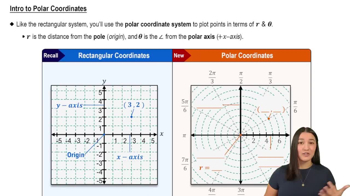
Polar coordinates represent points using a radius and an angle (r, θ) instead of Cartesian (x, y). Understanding how r changes with θ is essential for graphing polar equations like r = sin 3θ, where the radius depends on the angle multiplied by a factor.
Recommended video:
05:32
Intro to Polar Coordinates

Graphing Polar Curves

Graphing polar curves involves plotting points for various values of θ and connecting them smoothly. Recognizing patterns such as petals or loops, especially in equations like r = sin nθ, helps predict the shape and symmetry of the graph.
Recommended video:
09:04
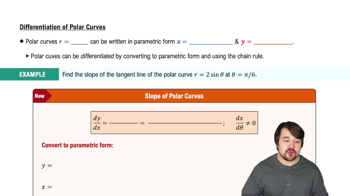
Slope of Polar Curves

Use of Graphing Utilities

Graphing utilities, such as graphing calculators or software, allow for accurate visualization of complex polar curves. They help verify manual sketches and reveal detailed features like the number of petals and symmetry in curves like r = sin 3θ.
Recommended video:
06:15
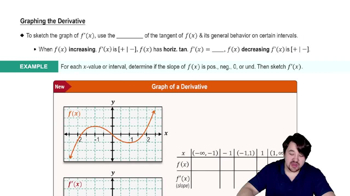
Graphing The Derivative
Related Practice
Textbook Question

77–80. Slopes of tangent lines Find all points at which the following curves have the given slope.


x = 2 + √t, y = 2 - 4t; slope = -8

Textbook Question

13–30. Graphing conic sections Determine whether the following equations describe a parabola, an ellipse, or a hyperbola, and then sketch a graph of the curve. For each parabola, specify the location of the focus and the equation of the directrix; for each ellipse, label the coordinates of the vertices and foci, and find the lengths of the major and minor axes; for each hyperbola, label the coordinates of the vertices and foci, and find the equations of the asymptotes.


25y² - 4x² = 100

1
views
Textbook Question

33–40. Areas of regions Make a sketch of the region and its bounding curves. Find the area of the region.


The region inside one leaf of r = cos 3θ

1
views
Textbook Question

49–52. Cartesian-to-polar coordinates Convert the following equations to polar coordinates.


y = x²

Textbook Question

13–30. Graphing conic sections Determine whether the following equations describe a parabola, an ellipse, or a hyperbola, and then sketch a graph of the curve. For each parabola, specify the location of the focus and the equation of the directrix; for each ellipse, label the coordinates of the vertices and foci, and find the lengths of the major and minor axes; for each hyperbola, label the coordinates of the vertices and foci, and find the equations of the asymptotes.


10x² - 7y² = 140

1
views
Textbook Question

53–56. Circular motion Find parametric equations that describe the circular path of the following objects. For Exercises 53–55, assume (x, y) denotes the position of the object relative to the origin at the center of the circle. Use the units of time specified in the problem. There are many ways to describe any circle.


The tip of the 15-inch second hand of a clock completes one revolution in 60 seconds.

1
views