
Ch. 8 - Integration Techniques
Briggs - Calculus: Early Transcendentals 3rd Edition
Briggs3rd EditionCalculus: Early TranscendentalsISBN: 9780136847243Not the one you use?Change textbook
Chapter 8, Problem 8.4.78c

Computing areas On the interval [0,2], the graphs of f(x)=x²/3 and g(x)=x²(9−x²)^(-1/2) have similar shapes.
c. Which region has greater area?

Verified step by step guidance
1
First, identify the two functions given: \(f(x) = \frac{x^{2}}{3}\) and \(g(x) = \frac{x^{2}}{\sqrt{9 - x^{2}}}\), both defined on the interval \([0, 2]\).
To compare the areas under the curves of \(f(x)\) and \(g(x)\) on \([0, 2]\), set up the definite integrals for each function: \(A_f = \int_0^2 \frac{x^{2}}{3} \, dx\) and \(A_g = \int_0^2 \frac{x^{2}}{\sqrt{9 - x^{2}}} \, dx\).
Evaluate each integral separately by applying appropriate integration techniques: for \(A_f\), use the power rule for integration; for \(A_g\), consider a trigonometric substitution such as \(x = 3 \sin \theta\) to simplify the integral.
After finding the expressions for both \(A_f\) and \(A_g\), compare their values to determine which area is greater.
Conclude which region has the greater area based on the comparison of the two definite integrals.

Verified video answer for a similar problem:

This video solution was recommended by our tutors as helpful for the problem above.
Video duration:
9m
Was this helpful?

Key Concepts

Here are the essential concepts you must grasp in order to answer the question correctly.

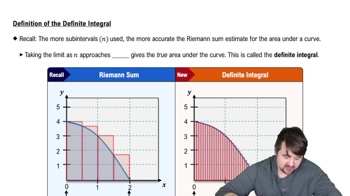
Definite Integral as Area Under a Curve

The definite integral of a function over an interval represents the net area between the graph of the function and the x-axis. To find the area of a region bounded by a curve and the x-axis, we compute the integral of the function over the given interval.
Recommended video:
05:43
Definition of the Definite Integral

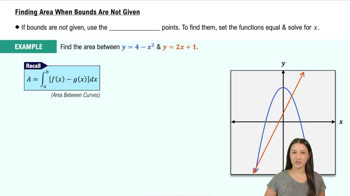
Comparing Areas of Two Functions

To determine which region has a greater area between two functions on the same interval, calculate the definite integrals of each function separately over that interval. The function with the larger integral value corresponds to the region with the greater area.
Recommended video:
05:06
Finding Area When Bounds Are Not Given

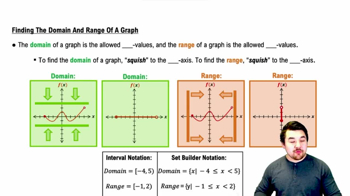
Handling Functions with Domain Restrictions

When dealing with functions like g(x) = x²(9−x²)^(-1/2), it is important to consider the domain where the function is defined and real-valued. Ensuring the function is integrable on the interval [0,2] is essential before computing the area.
Recommended video:
5:10
Finding the Domain and Range of a Graph
Related Practice
Textbook Question

45–48. {Use of Tech} Trapezoid Rule and Simpson’s Rule Consider the following integrals and the given values of n.

48. ∫(0 to π/4) (1/(1 + x²)) dx; n = 64

c. Compute the absolute errors in the Trapezoid Rule and Simpson’s Rule with 2n subintervals.

Textbook Question

82. A family of exponentials The curves y = x * e^(-a * x) are shown in the figure for a = 1, 2, and 3.

c. Find the area of the region bounded by y = x * e^(-a * x) and the x-axis on the interval [0, b]. Because this area depends on a and b, we call it A(a, b).

1
views
Textbook Question

43. A hot-air balloon is launched from an elevation of 5400 ft above sea level. As it rises, the vertical velocity is computed using a device (called a variometer) that measures the change in atmospheric pressure. The vertical velocities at selected times are shown in the table (with units of ft/min).

c. A polynomial that fits the data reasonably well is:

g(t) = 3.49t³ - 43.21t² + 142.43t - 1.75

Estimate the elevation of the balloon after five minutes using this polynomial.

1
views
Textbook Question

45–48. {Use of Tech} Trapezoid Rule and Simpson’s Rule Consider the following integrals and the given values of n.

45. ∫(0 to 1) e^(2x) dx; n = 25

c. Compute the absolute errors in the Trapezoid Rule and Simpson’s Rule with 2n subintervals.

Textbook Question

75. Exploring powers of sine and cosine

c. Prove that ∫₀ᵖⁱ sin²(nx) dx has the same value for all positive integers n.

Textbook Question

45–48. {Use of Tech} Trapezoid Rule and Simpson’s Rule Consider the following integrals and the given values of n.

47. ∫(1 to e) (1/x) dx; n = 50

c. Compute the absolute errors in the Trapezoid Rule and Simpson’s Rule with 2n subintervals.