

49. Explain why or why not Determine whether the following statements are true and give an explanation or counterexample:
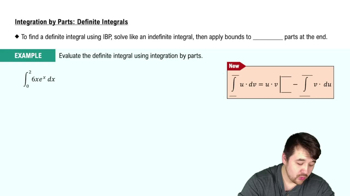
c. ∫ v du = u·v - ∫ u dv
Verified step by step guidance
49. Explain why or why not Determine whether the following statements are true and give an explanation or counterexample:
c. ∫ v du = u·v - ∫ u dv
45–48. {Use of Tech} Trapezoid Rule and Simpson’s Rule Consider the following integrals and the given values of n.
48. ∫(0 to π/4) (1/(1 + x²)) dx; n = 64
c. Compute the absolute errors in the Trapezoid Rule and Simpson’s Rule with 2n subintervals.
45–48. {Use of Tech} Trapezoid Rule and Simpson’s Rule Consider the following integrals and the given values of n.
45. ∫(0 to 1) e^(2x) dx; n = 25
c. Compute the absolute errors in the Trapezoid Rule and Simpson’s Rule with 2n subintervals.
75. Exploring powers of sine and cosine
c. Prove that ∫₀ᵖⁱ sin²(nx) dx has the same value for all positive integers n.
45–48. {Use of Tech} Trapezoid Rule and Simpson’s Rule Consider the following integrals and the given values of n.
47. ∫(1 to e) (1/x) dx; n = 50
c. Compute the absolute errors in the Trapezoid Rule and Simpson’s Rule with 2n subintervals.
Computing areas On the interval [0,2], the graphs of f(x)=x²/3 and g(x)=x²(9−x²)^(-1/2) have similar shapes.
c. Which region has greater area?