
Ch. 8 - Integration Techniques
Briggs - Calculus: Early Transcendentals 3rd Edition
Briggs3rd EditionCalculus: Early TranscendentalsISBN: 9780136847243Not the one you use?Change textbook
Chapter 8, Problem 8.9.91c

91. [Use of Tech] Regions bounded by exponentials Let a > 0 and let R be the region bounded by the graph of y = e^(-a·x) and the x-axis
on the interval [b, ∞).
c. Find the minimum value b* such that when b > b*, there exists some a > 0 where A(a,b) = 2.

Verified step by step guidance
1
First, understand the region R is bounded by the curve \(y = e^{-a \cdot x}\) and the x-axis over the interval \([b, \infty)\). The area \(A(a,b)\) of this region is given by the integral of the function from \(b\) to infinity: \[A(a,b) = \int_{b}^{\infty} e^{-a \cdot x} \, dx\]
Next, compute the integral \(A(a,b)\). Since \(a > 0\), the integral converges and can be evaluated as an improper integral: \[A(a,b) = \lim_{t \to \infty} \int_{b}^{t} e^{-a \cdot x} \, dx\] Use the antiderivative of \(e^{-a x}\), which is \(-\frac{1}{a} e^{-a x}\).
Evaluate the definite integral: \[A(a,b) = \lim_{t \to \infty} \left[-\frac{1}{a} e^{-a x} \right]_{x=b}^{x=t} = \lim_{t \to \infty} \left(-\frac{1}{a} e^{-a t} + \frac{1}{a} e^{-a b} \right)\] Since \(a > 0\), \(e^{-a t} \to 0\) as \(t \to \infty\), so the area simplifies to \[A(a,b) = \frac{1}{a} e^{-a b}\]
The problem asks to find the minimum value \(b^*\) such that for any \(b > b^*\), there exists some \(a > 0\) with \(A(a,b) = 2\). Set up the equation: \[\frac{1}{a} e^{-a b} = 2\] Rewrite it as \[e^{-a b} = 2a\]
To find \(b^*\), consider the function \(f(a) = 2a e^{a b}\). For fixed \(b\), the equation \(e^{-a b} = 2a\) can be rearranged to \(1 = 2a e^{a b}\). We want to find the smallest \(b\) such that this equation has a positive solution \(a\). Analyze the function \(g(a) = 2a e^{a b}\) for \(a > 0\) and find its minimum value with respect to \(a\). Then, find \(b^*\) such that the minimum of \(g(a)\) equals 1. This involves taking the derivative of \(g(a)\) with respect to \(a\), setting it to zero to find critical points, and solving for \(b\) in terms of \(a\). This will give the minimal \(b^*\).

Verified video answer for a similar problem:

This video solution was recommended by our tutors as helpful for the problem above.
Video duration:
7m
Was this helpful?

Key Concepts

Here are the essential concepts you must grasp in order to answer the question correctly.

Definite Integral and Area Under a Curve

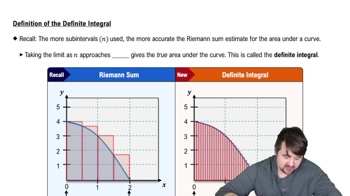
The definite integral calculates the area between a curve and the x-axis over a specified interval. For y = e^{-a·x}, integrating from b to infinity gives the total area under the exponential decay curve, which is essential for expressing A(a,b) and analyzing its behavior.
Recommended video:
05:43
Definition of the Definite Integral

Improper Integrals and Convergence

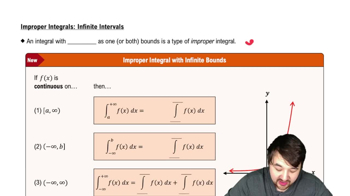
Integrals with infinite limits, like from b to ∞, are improper and require evaluating limits to determine convergence. Understanding when the integral converges and how it depends on parameters a and b is crucial to finding values where the area equals a specific number.
Recommended video:
11:11
Improper Integrals: Infinite Intervals

Parameter Dependence and Optimization

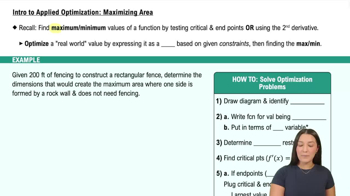
The problem involves finding a minimum b* such that for b > b*, there exists an a > 0 making the area equal to 2. This requires analyzing how the integral's value changes with parameters a and b, and using algebraic or calculus methods to solve for the critical threshold b*.
Recommended video:
10:13
Intro to Applied Optimization: Maximizing Area
Related Practice
Textbook Question

45–48. {Use of Tech} Trapezoid Rule and Simpson’s Rule Consider the following integrals and the given values of n.

46. ∫(0 to 2) x⁴ dx; n = 30

c. Compute the absolute errors in the Trapezoid Rule and Simpson’s Rule with 2n subintervals.

Textbook Question

109. Escape velocity and black holes The work required to launch an object from the surface of Earth to outer space is given by W = ∫ from R to ∞ of F(x) dx, where R = 6370 km is the approximate radius of Earth, F(x) = (GMm)/x² is the gravitational force between Earth and the object, G is the gravitational constant, M is the mass of Earth, m is the mass of the object, and GM = 4 × 10¹⁴ m³/s².

c. The French scientist Laplace anticipated the existence of black holes in the 18th century with the following argument: If a body has an escape velocity that equals or exceeds the speed of light, c = 300,000 km/s, then light cannot escape the body and it cannot be seen. Show that such a body has a radius R ≤ 2GM/c². For Earth to be a black hole, what would its radius need to be?

1
views
Textbook Question

58. Two Methods Evaluate ∫(from 0 to π/3) sin(x) · ln(cos(x)) dx in the following two ways:

b. Use substitution.

Textbook Question

94. [Use of Tech] Skydiving A skydiver has a downward velocity given by v(t) = V_T [(1 - e^(-2gt/V_T))/(1 + e^(-2gt/V_T))],

where t = 0 is the instant the skydiver starts falling, g = 9.8 m/s² is the acceleration due to gravity, and V_T is the terminal velocity of the skydiver.

c. Verify by integration that the position function is given by

s(t) = V_T t + (V_T²/g) ln[(1 + e^(-2gt/V_T))/2],

where s'(t) = v(t) and s(0) = 0.

1
views
Textbook Question

59. Two Methods

b. Evaluate ∫(x / √(x + 1)) dx using substitution.

1
views
Textbook Question

75. {Use of Tech} Oscillator displacements Suppose a mass on a spring that is slowed by friction has the position function:

s(t) = e⁻ᵗ sin t

c. Generalize part (b) and find the average value of the position on the interval [nπ, (n+1)π], for n = 0, 1, 2, ...