
Ch. 8 - Integration Techniques
Briggs - Calculus: Early Transcendentals 3rd Edition
Briggs3rd EditionCalculus: Early TranscendentalsISBN: 9780136847243Not the one you use?Change textbook
Chapter 8, Problem 8.3.75c

75. Exploring powers of sine and cosine
c. Prove that ∫₀ᵖⁱ sin²(nx) dx has the same value for all positive integers n.

Verified step by step guidance
1
Step 1: Begin by recalling the trigonometric identity for sine squared: sin²(x) = (1 - cos(2x))/2. This identity will simplify the integral.
Step 2: Substitute sin²(nx) in the integral with the identity: ∫₀ᵖⁱ sin²(nx) dx = ∫₀ᵖⁱ (1 - cos(2nx))/2 dx. Split the integral into two parts: ∫₀ᵖⁱ (1/2) dx - ∫₀ᵖⁱ (cos(2nx)/2) dx.
Step 3: Evaluate the first integral ∫₀ᵖⁱ (1/2) dx. Since this is a constant, the result is straightforward: (1/2) * x evaluated from 0 to π.
Step 4: For the second integral ∫₀ᵖⁱ (cos(2nx)/2) dx, recall that the integral of cosine over a full period (or multiples of π) is zero. Specifically, ∫₀ᵖⁱ cos(2nx) dx = 0 for any positive integer n.
Step 5: Combine the results from Step 3 and Step 4. The first integral contributes a constant value, while the second integral contributes zero. Therefore, the value of ∫₀ᵖⁱ sin²(nx) dx is independent of n and remains the same for all positive integers.

Verified video answer for a similar problem:

This video solution was recommended by our tutors as helpful for the problem above.
Video duration:
3m
Was this helpful?

Key Concepts

Here are the essential concepts you must grasp in order to answer the question correctly.

Definite Integrals

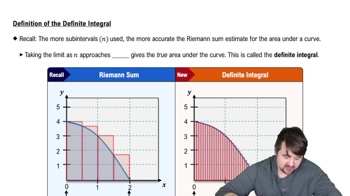
A definite integral calculates the accumulation of a function's values over a specific interval, providing the net area under the curve. In this case, the integral ∫₀ᵖⁱ sin²(nx) dx evaluates the area under the sine squared function from 0 to π, which is crucial for proving the equality for different values of n.
Recommended video:
05:43
Definition of the Definite Integral

Trigonometric Identities

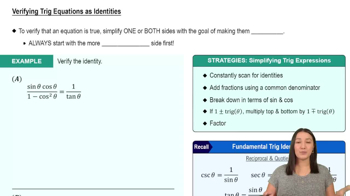
Trigonometric identities are equations involving trigonometric functions that hold true for all values of the variables. The identity sin²(x) = (1 - cos(2x))/2 is particularly useful in this context, as it simplifies the integral of sin²(nx) and allows for easier evaluation across different integer values of n.
Recommended video:
7:17
Verifying Trig Equations as Identities

Periodicity of Sine Function

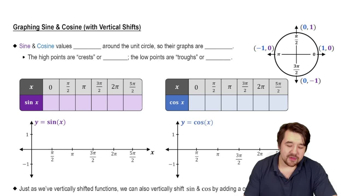
The sine function is periodic, meaning it repeats its values in regular intervals. For sin²(nx), the period is π/n, which implies that as n changes, the function still retains a consistent average value over the interval [0, π]. This periodicity is key to demonstrating that the integral yields the same result for all positive integers n.
Recommended video:
5:53
Graph of Sine and Cosine Function
Related Practice
Textbook Question

49. Explain why or why not Determine whether the following statements are true and give an explanation or counterexample:

c. ∫ v du = u·v - ∫ u dv

1
views
Textbook Question

45–48. {Use of Tech} Trapezoid Rule and Simpson’s Rule Consider the following integrals and the given values of n.

48. ∫(0 to π/4) (1/(1 + x²)) dx; n = 64

c. Compute the absolute errors in the Trapezoid Rule and Simpson’s Rule with 2n subintervals.

Textbook Question

43. A hot-air balloon is launched from an elevation of 5400 ft above sea level. As it rises, the vertical velocity is computed using a device (called a variometer) that measures the change in atmospheric pressure. The vertical velocities at selected times are shown in the table (with units of ft/min).

c. A polynomial that fits the data reasonably well is:

g(t) = 3.49t³ - 43.21t² + 142.43t - 1.75

Estimate the elevation of the balloon after five minutes using this polynomial.

1
views
Textbook Question

45–48. {Use of Tech} Trapezoid Rule and Simpson’s Rule Consider the following integrals and the given values of n.

45. ∫(0 to 1) e^(2x) dx; n = 25

c. Compute the absolute errors in the Trapezoid Rule and Simpson’s Rule with 2n subintervals.

Textbook Question

Computing areas On the interval [0,2], the graphs of f(x)=x²/3 and g(x)=x²(9−x²)^(-1/2) have similar shapes.

c. Which region has greater area?

1
views
Textbook Question

3. What term(s) should appear in the partial fraction decomposition of a proper rational function with each of the following?

c. A factor of (x² + 2x + 6) in the denominator

1
views