Ch. 8 - Integration Techniques
Briggs - Calculus: Early Transcendentals 3rd Edition
Briggs3rd EditionCalculus: Early TranscendentalsISBN: 9780136847243Not the one you use?Change textbook
Chapter 8, Problem 8.2.82c

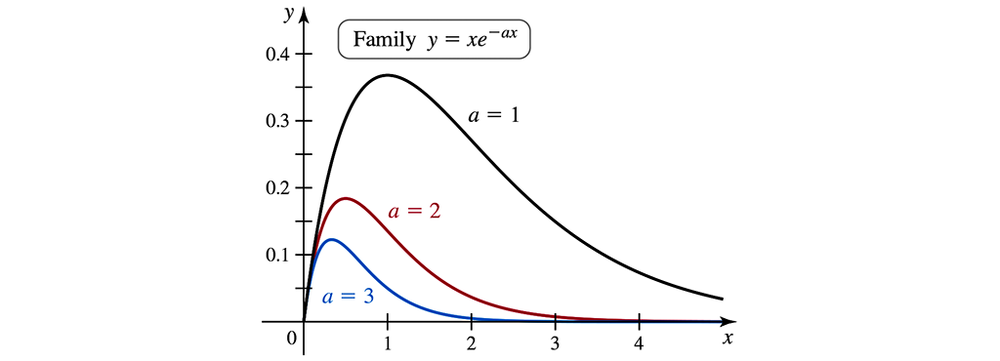
82. A family of exponentials The curves y = x * e^(-a * x) are shown in the figure for a = 1, 2, and 3.
c. Find the area of the region bounded by y = x * e^(-a * x) and the x-axis on the interval [0, b]. Because this area depends on a and b, we call it A(a, b).
Graph showing three curves of y = x * e^(-a * x) for a = 1, 2, and 3, all approaching the x-axis.

Verified step by step guidance
1
Identify the function and the interval for the area calculation. The function is given by \(y = x e^{-a x}\), and the area \(A(a, b)\) is the integral of this function from \(0\) to \(b\).
Set up the definite integral to find the area under the curve and above the x-axis on the interval \([0, b]\): \(A(a, b) = \int_0^b x e^{-a x} \, dx\)
To solve the integral, use integration by parts. Let \(u = x\) and \(dv = e^{-a x} dx\). Then, compute \(du = dx\) and find \(v\) by integrating \(dv\): \(v = \int e^{-a x} dx = -\frac{1}{a} e^{-a x}\)
Apply the integration by parts formula: \(\int u \, dv = uv - \int v \, du\), which gives \(\int_0^b x e^{-a x} dx = \left. -\frac{x}{a} e^{-a x} \right|_0^b + \frac{1}{a} \int_0^b e^{-a x} dx\)
Evaluate the remaining integral \(\int_0^b e^{-a x} dx\) and then substitute the limits \(0\) and \(b\) into the expression to write \(A(a, b)\) explicitly in terms of \(a\) and \(b\).

Verified video answer for a similar problem:

This video solution was recommended by our tutors as helpful for the problem above.
Video duration:
6m
Was this helpful?

Key Concepts

Here are the essential concepts you must grasp in order to answer the question correctly.

Definite Integral and Area Under a Curve

The definite integral of a function over an interval [0, b] represents the area under the curve between those points. For the function y = x * e^(-a * x), integrating from 0 to b calculates the area bounded by the curve and the x-axis, which depends on both parameters a and b.
Recommended video:
05:43
Definition of the Definite Integral

Integration of Exponential Functions

Integrating functions involving exponentials like e^(-a * x) often requires techniques such as integration by parts. Since y = x * e^(-a * x) is a product of x and an exponential, applying integration by parts helps to find an explicit formula for the integral and thus the area A(a, b).
Recommended video:
05:11
Integrals of General Exponential Functions

Parameter Dependence in Families of Functions

The parameter 'a' in y = x * e^(-a * x) affects the shape and decay rate of the curve. Understanding how the integral (area) changes with 'a' and the upper limit 'b' is crucial for analyzing the family of curves and how the bounded area varies with these parameters.
Recommended video:
Guided course
05:59
Eliminating the Parameter
Related Practice
Textbook Question

45–48. {Use of Tech} Trapezoid Rule and Simpson’s Rule Consider the following integrals and the given values of n.

48. ∫(0 to π/4) (1/(1 + x²)) dx; n = 64

c. Compute the absolute errors in the Trapezoid Rule and Simpson’s Rule with 2n subintervals.

Textbook Question

Gaussians An important function in statistics is the Gaussian (or normal distribution, or bell-shaped curve), f(x) = e^(-ax²).

c. Complete the square to evaluate ∫ from -∞ to ∞ of e^(-(ax² + bx + c)) dx, where a > 0, b, and c are real numbers.

1
views
Textbook Question

45–48. {Use of Tech} Trapezoid Rule and Simpson’s Rule Consider the following integrals and the given values of n.

47. ∫(1 to e) (1/x) dx; n = 50

c. Compute the absolute errors in the Trapezoid Rule and Simpson’s Rule with 2n subintervals.

Textbook Question

Computing areas On the interval [0,2], the graphs of f(x)=x²/3 and g(x)=x²(9−x²)^(-1/2) have similar shapes.

c. Which region has greater area?

1
views
Textbook Question

Explain why or why not Determine whether the following statements are true and give an explanation or counterexample.

d. Using the substitution u = tan(x) in ∫ (tan²x / (tan x - 1)) dx leads to ∫ (u² / (u - 1)) du.

Textbook Question

77. Tabular integration Consider the integral ∫ f(x)g(x) dx, where f can be differentiated repeatedly and g can be integrated repeatedly

Let Gₖ represent the result of calculating k indefinite integrals of g (omitting constants of integration).

d. The tabular integration table from part (c) is easily extended to allow for as many steps as necessary in the process of integration by parts.

Evaluate ∫ x² e^(x/2) dx by constructing an appropriate table, and explain why the process terminates after four rows of the table have been filled in.

1
views