
Ch. 8 - Integration Techniques
Briggs - Calculus: Early Transcendentals 3rd Edition
Briggs3rd EditionCalculus: Early TranscendentalsISBN: 9780136847243Not the one you use?Change textbook
Chapter 8, Problem 8.2.77d

77. Tabular integration Consider the integral ∫ f(x)g(x) dx, where f can be differentiated repeatedly and g can be integrated repeatedly
Let Gₖ represent the result of calculating k indefinite integrals of g (omitting constants of integration).
d. The tabular integration table from part (c) is easily extended to allow for as many steps as necessary in the process of integration by parts.
Evaluate ∫ x² e^(x/2) dx by constructing an appropriate table, and explain why the process terminates after four rows of the table have been filled in.

Verified step by step guidance
1
Identify the functions for integration by parts: let \( f(x) = x^2 \) (which can be differentiated repeatedly) and \( g(x) = e^{x/2} \) (which can be integrated repeatedly).
Construct a table with two columns: one for successive derivatives of \( f(x) \) and one for successive integrals of \( g(x) \). Start by listing \( f(x) \) and its derivatives down the left column, and \( g(x) \) and its integrals down the right column.
Calculate the derivatives of \( f(x) = x^2 \): \( f'(x) = 2x \), \( f''(x) = 2 \), and \( f'''(x) = 0 \). This shows the differentiation process will terminate after the third derivative because the derivative becomes zero.
Calculate the integrals of \( g(x) = e^{x/2} \): the first integral is \( G_1 = \int e^{x/2} dx \), the second integral \( G_2 = \int G_1 dx \), and so on, each time integrating the previous result.
Use the tabular integration method by multiplying diagonally and alternating signs (+, -, +, -) to write the sum of products of derivatives of \( f \) and integrals of \( g \). The process terminates after four rows because the derivative of \( f \) becomes zero, so no further terms contribute to the integral.

Verified video answer for a similar problem:

This video solution was recommended by our tutors as helpful for the problem above.
Video duration:
4m
Was this helpful?

Key Concepts

Here are the essential concepts you must grasp in order to answer the question correctly.

Integration by Parts

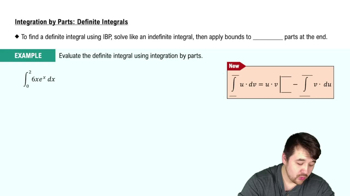
Integration by parts is a technique derived from the product rule of differentiation. It transforms the integral of a product of functions into simpler integrals, using the formula ∫u dv = uv - ∫v du. Choosing u and dv wisely simplifies the problem, especially when one function becomes simpler upon differentiation.
Recommended video:
06:18
Integration by Parts for Definite Integrals

Tabular Integration Method

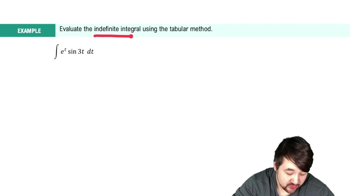
Tabular integration is a streamlined approach to repeated integration by parts. It organizes derivatives of one function and integrals of the other in a table, alternating signs to quickly sum terms. This method is efficient when one function differentiates to zero after finite steps, allowing the process to terminate naturally.
Recommended video:
09:15
Tabular Integration by Parts Example 6

Termination of the Integration Process

The integration process terminates when repeated differentiation of one function results in zero, eliminating further terms. In the example ∫ x² e^(x/2) dx, differentiating x² repeatedly leads to zero after the third derivative, so the tabular method ends after four rows, ensuring a finite and complete solution.
Recommended video:
06:18
Integration by Parts for Definite Integrals
Related Practice
Textbook Question

The Eiffel Tower Property Let R be the region between the curves y = e^(-c·x) and y = -e^(-c·x) on the interval [a, ∞), where a ≥ 0 and c > 0.

The center of mass of R is located at (x̄, 0), where x̄ = [∫(a to ∞) x·e^(-c·x) dx] / [∫(a to ∞) e^(-c·x) dx]

(The profile of the Eiffel Tower is modeled by these two exponential curves; see the Guided Project "The exponential Eiffel Tower")

d. Prove this property holds for any a ≥ 0 and c > 0:

The tangent lines to y = ±e^(-c·x) at x = a always intersect at R's center of mass

(Source: P. Weidman and I. Pinelis, Comptes Rendu, Mechanique, 332, 571-584, 2004)

1
views
Textbook Question

82. A family of exponentials The curves y = x * e^(-a * x) are shown in the figure for a = 1, 2, and 3.

c. Find the area of the region bounded by y = x * e^(-a * x) and the x-axis on the interval [0, b]. Because this area depends on a and b, we call it A(a, b).

1
views
Textbook Question

Gaussians An important function in statistics is the Gaussian (or normal distribution, or bell-shaped curve), f(x) = e^(-ax²).

c. Complete the square to evaluate ∫ from -∞ to ∞ of e^(-(ax² + bx + c)) dx, where a > 0, b, and c are real numbers.

1
views
Textbook Question

45–48. {Use of Tech} Trapezoid Rule and Simpson’s Rule Consider the following integrals and the given values of n.

47. ∫(1 to e) (1/x) dx; n = 50

c. Compute the absolute errors in the Trapezoid Rule and Simpson’s Rule with 2n subintervals.

Textbook Question

Explain why or why not Determine whether the following statements are true and give an explanation or counterexample.

d. Using the substitution u = tan(x) in ∫ (tan²x / (tan x - 1)) dx leads to ∫ (u² / (u - 1)) du.

Textbook Question

101. Many methods needed Show that the integral from ∫(from 0 to ∞)(sqrt(x) * ln x) / (1 + x)^2 dx equals pi, following these steps

d. Evaluate the remaining integral using the change of variables z = sqrt(x)

2
views