
Ch. 8 - Integration Techniques
Briggs - Calculus: Early Transcendentals 3rd Edition
Briggs3rd EditionCalculus: Early TranscendentalsISBN: 9780136847243Not the one you use?Change textbook
Chapter 8, Problem 8.9.100d

The Eiffel Tower Property Let R be the region between the curves y = e^(-c·x) and y = -e^(-c·x) on the interval [a, ∞), where a ≥ 0 and c > 0.
The center of mass of R is located at (x̄, 0), where x̄ = [∫(a to ∞) x·e^(-c·x) dx] / [∫(a to ∞) e^(-c·x) dx]
(The profile of the Eiffel Tower is modeled by these two exponential curves; see the Guided Project "The exponential Eiffel Tower")
d. Prove this property holds for any a ≥ 0 and c > 0:
The tangent lines to y = ±e^(-c·x) at x = a always intersect at R's center of mass
(Source: P. Weidman and I. Pinelis, Comptes Rendu, Mechanique, 332, 571-584, 2004)

Verified step by step guidance
1
First, write down the equations of the tangent lines to the curves \(y = e^{-c\cdot x}\) and \(y = -e^{-c\cdot x}\) at the point \(x = a\). To do this, find the derivatives of both functions at \(x = a\):
Calculate the derivative of \(y = e^{-c\cdot x}\), which is \(y' = -c e^{-c\cdot x}\). Evaluate this at \(x = a\) to get the slope of the tangent line: \(m = -c e^{-c a}\). Similarly, the derivative of \(y = -e^{-c\cdot x}\) is \(y' = c e^{-c\cdot x}\), and at \(x = a\) the slope is \(m = c e^{-c a}\).
Write the equations of the tangent lines using point-slope form. For the upper curve, the tangent line at \((a, e^{-c a})\) is: \[ y = e^{-c a} + (-c e^{-c a})(x - a) = e^{-c a} - c e^{-c a} (x - a) \] For the lower curve, the tangent line at \((a, -e^{-c a})\) is: \[ y = -e^{-c a} + (c e^{-c a})(x - a) = -e^{-c a} + c e^{-c a} (x - a) \]
Find the intersection point \((x_I, y_I)\) of these two tangent lines by setting their \(y\) values equal: \[ e^{-c a} - c e^{-c a} (x_I - a) = -e^{-c a} + c e^{-c a} (x_I - a) \] Simplify this equation to solve for \(x_I\).
After solving for \(x_I\), observe that the \(y\)-coordinate of the intersection \(y_I\) is zero due to symmetry. Then, compare \(x_I\) with the expression for the center of mass \(\bar{x} = \frac{\int_a^{\infty} x e^{-c x} dx}{\int_a^{\infty} e^{-c x} dx}\). Show that \(x_I = \bar{x}\), thus proving that the tangent lines intersect at the center of mass for any \(a \geq 0\) and \(c > 0\).

Verified video answer for a similar problem:

This video solution was recommended by our tutors as helpful for the problem above.
Video duration:
6m
Was this helpful?

Key Concepts

Here are the essential concepts you must grasp in order to answer the question correctly.

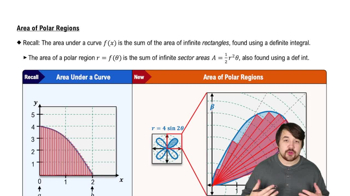
Center of Mass for a Planar Region

The center of mass (centroid) of a planar region is the average position of all points in the region, weighted by area. For regions bounded by curves, it is found using integrals of the form x̄ = (∫ x·f(x) dx) / (∫ f(x) dx), where f(x) represents the vertical distance between curves. This concept helps locate the balance point of the region.
Recommended video:
07:45
Area of Polar Regions

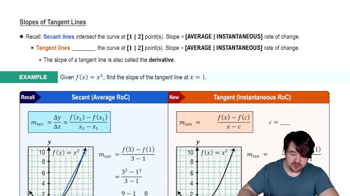
Tangent Lines to Exponential Curves

A tangent line to a curve at a point touches the curve without crossing it and has a slope equal to the derivative at that point. For y = ±e^(-c·x), the derivative is ±(-c)e^(-c·x). Understanding these tangent lines at x = a is essential to analyze their intersection and relate it to the center of mass.
Recommended video:
05:13
Slopes of Tangent Lines

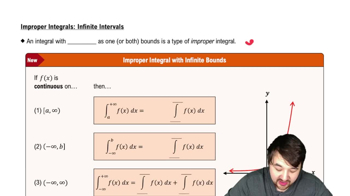
Improper Integrals and Convergence on [a, ∞)

Integrals over infinite intervals, like ∫_a^∞ e^(-c·x) dx, are improper integrals that converge if the integrand decays sufficiently fast. Here, the exponential decay ensures convergence for c > 0. Evaluating these integrals is crucial to compute the center of mass and prove properties involving infinite domains.
Recommended video:
11:11
Improper Integrals: Infinite Intervals
Related Practice
Textbook Question

66–71. {Use of Tech} Estimating error Refer to Theorem 8.1 in the following exercises.

66. Let f(x) = cos(x²).

d. Use Theorem 8.1 to find an upper bound on the absolute error in the estimate found in part (a).

Textbook Question

Gaussians An important function in statistics is the Gaussian (or normal distribution, or bell-shaped curve), f(x) = e^(-ax²).

c. Complete the square to evaluate ∫ from -∞ to ∞ of e^(-(ax² + bx + c)) dx, where a > 0, b, and c are real numbers.

1
views
Textbook Question

Explain why or why not Determine whether the following statements are true and give an explanation or counterexample.

d. Using the substitution u = tan(x) in ∫ (tan²x / (tan x - 1)) dx leads to ∫ (u² / (u - 1)) du.

Textbook Question

101. Many methods needed Show that the integral from ∫(from 0 to ∞)(sqrt(x) * ln x) / (1 + x)^2 dx equals pi, following these steps

d. Evaluate the remaining integral using the change of variables z = sqrt(x)

2
views
Textbook Question

 Explain why or why not Determine whether the following statements are true and give an explanation or counterexample.

d. ∫(1/eˣ) dx = ln eˣ + C.

Textbook Question

77. Tabular integration Consider the integral ∫ f(x)g(x) dx, where f can be differentiated repeatedly and g can be integrated repeatedly

Let Gₖ represent the result of calculating k indefinite integrals of g (omitting constants of integration).

d. The tabular integration table from part (c) is easily extended to allow for as many steps as necessary in the process of integration by parts.

Evaluate ∫ x² e^(x/2) dx by constructing an appropriate table, and explain why the process terminates after four rows of the table have been filled in.

1
views