Ch. 8 - Integration Techniques
Briggs - Calculus: Early Transcendentals 3rd Edition
Briggs3rd EditionCalculus: Early TranscendentalsISBN: 9780136847243Not the one you use?Change textbook
Chapter 8, Problem 8.8.66d

66–71. {Use of Tech} Estimating error Refer to Theorem 8.1 in the following exercises.
66. Let f(x) = cos(x²).
d. Use Theorem 8.1 to find an upper bound on the absolute error in the estimate found in part (a).

Verified step by step guidance
1
Understand Theorem 8.1: The theorem provides a way to estimate the error in approximating a definite integral using numerical methods. Specifically, it involves the second derivative of the function and the width of the interval.
Identify the function and its derivatives: The given function is f(x) = cos(x²). Compute the second derivative of f(x), which will be needed to apply Theorem 8.1. Start by finding the first derivative f'(x) = -2x*sin(x²), and then compute the second derivative f''(x).
Determine the maximum value of |f''(x)|: To apply Theorem 8.1, find the maximum absolute value of the second derivative |f''(x)| over the interval of integration. This may involve analyzing critical points or using technology to evaluate the maximum value numerically.
Apply Theorem 8.1 formula: The error bound is given by the formula E ≤ (K(b-a)³)/(12n²), where K is the maximum value of |f''(x)|, [a, b] is the interval of integration, and n is the number of subintervals used in the numerical method (e.g., trapezoidal rule or Simpson's rule). Substitute the values into this formula.
Interpret the result: The computed upper bound provides an estimate of the maximum possible error in the numerical approximation of the integral. This helps assess the accuracy of the method used in part (a).

Verified video answer for a similar problem:

This video solution was recommended by our tutors as helpful for the problem above.
Video duration:
2m
Was this helpful?

Key Concepts

Here are the essential concepts you must grasp in order to answer the question correctly.

Theorem 8.1 (Taylor's Theorem)

Theorem 8.1, often referred to as Taylor's Theorem, provides a framework for approximating a function using its derivatives at a specific point. It states that a function can be expressed as a Taylor series, and the remainder term quantifies the error in this approximation. Understanding this theorem is crucial for estimating the accuracy of polynomial approximations of functions.
Recommended video:
06:11
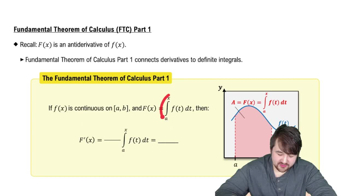
Fundamental Theorem of Calculus Part 1

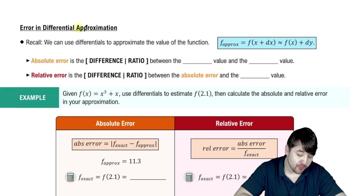
Absolute Error

Absolute error measures the difference between the true value of a function and its estimated value. It is calculated as the absolute value of the difference, providing a straightforward way to assess the accuracy of an approximation. In the context of Theorem 8.1, finding an upper bound on the absolute error helps determine how close the approximation is to the actual function.
Recommended video:
04:57
Determining Error and Relative Error

Upper Bound

An upper bound is a value that serves as a limit, indicating that the actual value will not exceed this threshold. In calculus, particularly when estimating errors, finding an upper bound on the absolute error allows mathematicians to understand the worst-case scenario for the accuracy of their approximations. This concept is essential for ensuring that estimates remain within acceptable limits.
Recommended video:
05:06
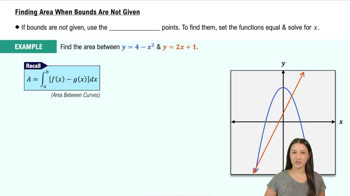
Finding Area When Bounds Are Not Given
Related Practice
Textbook Question

The Eiffel Tower Property Let R be the region between the curves y = e^(-c·x) and y = -e^(-c·x) on the interval [a, ∞), where a ≥ 0 and c > 0.

The center of mass of R is located at (x̄, 0), where x̄ = [∫(a to ∞) x·e^(-c·x) dx] / [∫(a to ∞) e^(-c·x) dx]

(The profile of the Eiffel Tower is modeled by these two exponential curves; see the Guided Project "The exponential Eiffel Tower")

d. Prove this property holds for any a ≥ 0 and c > 0:

The tangent lines to y = ±e^(-c·x) at x = a always intersect at R's center of mass

(Source: P. Weidman and I. Pinelis, Comptes Rendu, Mechanique, 332, 571-584, 2004)

1
views
Textbook Question

87. Explain why or why not Determine whether the following statements are true and give an explanation or counterexample.

d. If ∫(from 1 to ∞) x^(-p) dx exists, then ∫(from 1 to ∞) x^(-q) dx exists (where q > p).

1
views

Textbook Question

66–71. {Use of Tech} Estimating error Refer to Theorem 8.1 in the following exercises.

69. Let f(x) = sin(eˣ).

d. Find an upper bound on the absolute error in the estimate found in part (a) using Theorem 8.1.

Textbook Question

101. Many methods needed Show that the integral from ∫(from 0 to ∞)(sqrt(x) * ln x) / (1 + x)^2 dx equals pi, following these steps

d. Evaluate the remaining integral using the change of variables z = sqrt(x)

2
views
Textbook Question

2. Give an example of each of the following.

d. A repeated irreducible quadratic factor

Textbook Question

 Explain why or why not Determine whether the following statements are true and give an explanation or counterexample.

d. ∫(1/eˣ) dx = ln eˣ + C.